Introduction
Social media marketing has entered a new phase.
For years, marketers measured success primarily through follower counts, likes, views, and comments. While these metrics remain useful, they do not always explain whether an account is reaching the right people.
In 2026, the bigger question is becoming:
Can technology help brands find, understand, and engage the audiences most relevant to them?
Artificial intelligence is increasingly becoming part of that answer.
Modern AI systems can analyze enormous amounts of information, identify behavioral patterns, understand content, summarize campaign performance, and provide recommendations. Social platforms themselves are using AI extensively to personalize discovery and recommendations. Meta, for example, describes AI systems that analyze content and user interests to match people with potentially relevant posts and Reels.
This evolution is also influencing the SMM panel industry.
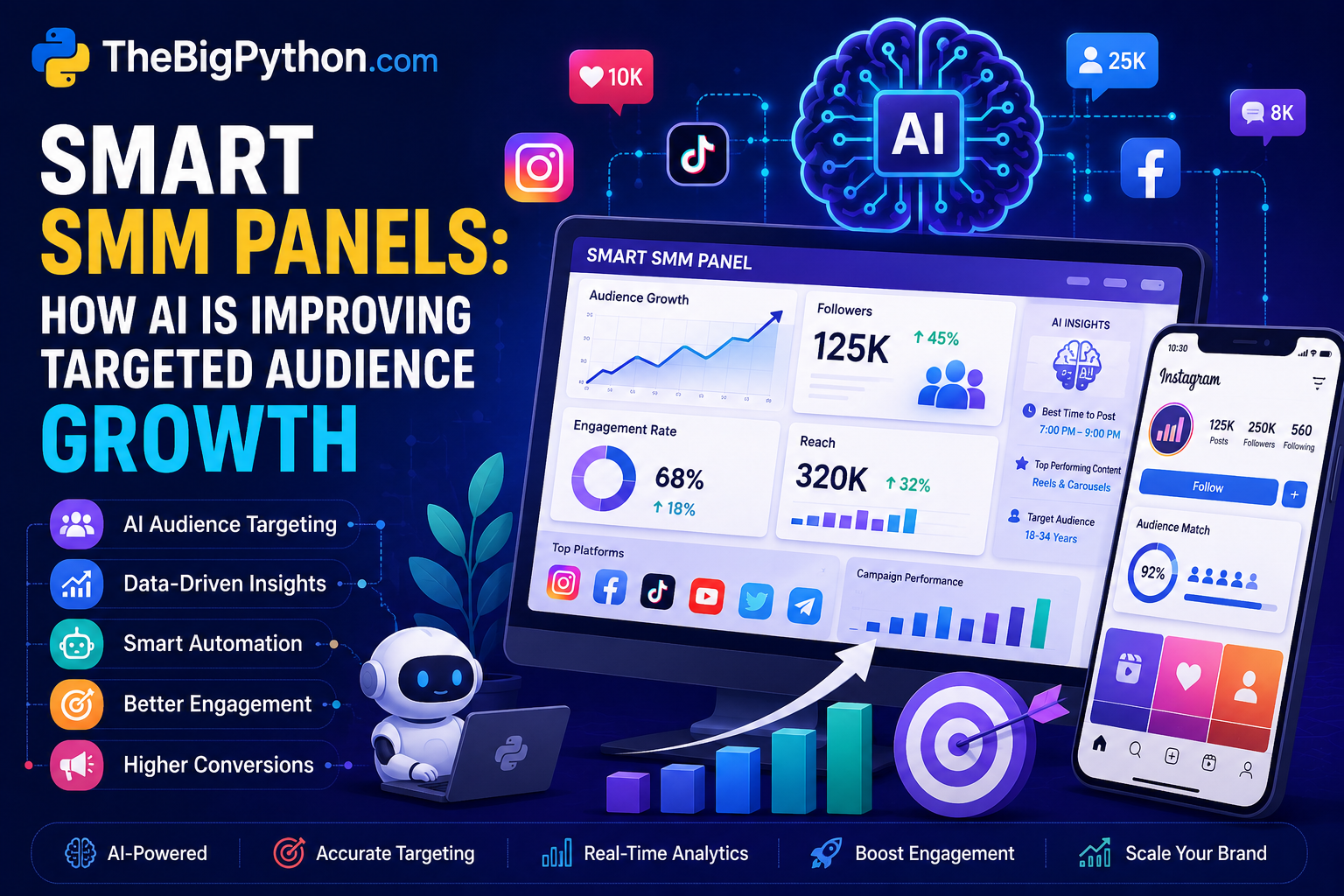
Instead of thinking about an SMM panel as simply a marketplace for social media services, marketers can increasingly view it as a campaign management and intelligence platform.
That shift could make AI-powered SMM panels one of the more interesting developments in social media marketing.
What Is an AI-Powered SMM Panel?
An AI-powered SMM panel combines traditional social media marketing functionality with artificial intelligence and data analysis.
A conventional panel may allow users to manage services such as:
- Followers
- Likes
- Views
- Comments
- Shares
- Reactions
- Social media campaigns
- API orders
An AI-powered platform can add another layer of intelligence.
For example, it may help users understand:
- Which content performs best
- Which topics attract the strongest response
- Which audiences interact most frequently
- When content tends to perform better
- Which campaigns are losing momentum
- Which content formats deserve additional testing
- How performance changes across platforms
The important difference is simple:
Traditional automation performs tasks. AI-assisted automation can help inform decisions.
Why AI Matters for Social Media Growth
Social media produces enormous amounts of data every day.
Every post can generate multiple signals:
- Views
- Watch time
- Likes
- Comments
- Shares
- Saves
- Profile visits
- Follows
- Clicks
- Reposts
- Audience retention
Manually analyzing all of these signals becomes difficult as an account grows.
AI can process large datasets much faster.
This makes it possible to identify relationships that might otherwise be difficult to notice.
For example, an AI system might discover that:
Educational Reels generate 35% more shares than promotional Reels.
That insight can influence future content planning.
The purpose is not simply to create more content.
It is to create more relevant content.
AI Is Already Changing Social Media Discovery
AI-powered recommendations are not a theoretical future.
They are already part of major social platforms.
Instagram explains that recommendations can appear in Explore, Reels, Feed Recommendations, and suggested accounts, helping users discover content from accounts they do not already follow.
Instagram also says suggested posts can be influenced by factors such as user activity, connections, information about the post, and information about the account.
This has an important implication for marketers.
The objective should not simply be:
"How can I increase my numbers?"
Instead, the objective should become:
"How can I create content that is relevant to the audience I want to reach?"
AI-powered SMM tools can help marketers work toward that goal.
AI Can Analyze Audience Interests
One of the most useful applications of AI is audience analysis.
A smart platform can examine performance data and identify patterns across different content categories.
For example, a fashion brand might discover that its audience responds particularly well to:
- Styling tutorials
- Budget fashion tips
- Seasonal outfits
- Before-and-after videos
At the same time, purely promotional posts may receive weaker engagement.
That information provides a strategic direction.
Instead of publishing whatever comes to mind, the brand can develop more content around proven audience interests.
This is the difference between random posting and data-informed content planning.
AI Can Identify High-Value Content
Not every high-view post is necessarily valuable.
Imagine two posts:
Post A
100,000 views
1,000 likes
20 comments
10 shares
Post B
30,000 views
1,500 likes
200 comments
500 shares
Post A generated more views.
But Post B may have created a much stronger connection with its audience.
AI can help marketers compare multiple performance signals instead of relying on one metric.
This can help identify content that generates:
- Meaningful interaction
- Repeat viewers
- Shares
- Saves
- Profile visits
- Follower conversions
- Website traffic
The result is a more complete picture of content performance.
AI-Powered Content Recommendations
Another major advantage is content recommendation.
An intelligent SMM platform can analyze historical performance and suggest potential content directions.
For example:
Previous high-performing topic: Instagram Reels tips
Possible recommendations:
- Reels editing tutorials
- Reels hook ideas
- Reels analytics guides
- Common Reels mistakes
- Short-form content strategies
The AI does not need to replace the creator.
Instead, it can act as a research assistant.
This approach is already appearing within social platforms. Meta introduced an AI creator assistant in 2026 designed to provide personalized recommendations based on creators' content, performance, communities, and goals.
That trend demonstrates how social media tools are moving toward personalized, conversational assistance.
AI Can Improve Campaign Timing
Timing has always been an important part of social media marketing.
Different audiences have different habits.
A business targeting professionals may see different activity patterns from a gaming creator targeting teenagers.
AI can analyze historical data to identify potential patterns such as:
- Strong engagement windows
- High-view periods
- Audience activity changes
- Weekday versus weekend performance
- Content-specific timing
A smart panel could then use these insights to help marketers plan campaigns.
However, recommendations should be treated as starting points rather than guarantees.
Audience behavior changes constantly.
Intelligent Drip-Feed Campaigns
Drip-feed campaigns are designed to distribute activity gradually instead of delivering everything at once.
AI can potentially make these campaigns more responsive.
For example, a system could monitor campaign performance and help identify whether activity is:
- Increasing
- Stable
- Declining
- Producing unexpected results
This can provide marketers with better visibility into campaign behavior.
The important principle is responsible automation.
Automation should reduce repetitive work and improve campaign organization rather than encourage spam or misleading activity.
AI Can Help Agencies Manage Multiple Clients
AI-powered SMM panels can be particularly valuable for agencies.
Imagine an agency managing 50 social media accounts.
Without automation, employees may need to manually review:
- Analytics
- Campaign status
- Content performance
- Engagement changes
- Client reports
- Growth trends
AI can help summarize these areas.
Instead of manually reviewing every dashboard, an agency could receive alerts such as:
Client A's Reels engagement increased significantly this week.
Or:
Client B's educational content is outperforming promotional content.
Or:
Client C's engagement rate has declined for three consecutive weeks.
This saves time and allows agency employees to focus more heavily on strategy.
AI and Cross-Platform Marketing
Modern brands rarely rely on only one social network.
A single campaign may involve:
- TikTok
- YouTube
- X
- Telegram
Each platform has different audiences and content formats.
AI can help compare performance across these platforms.
For example:
| Platform | Useful AI Analysis |
|---|---|
| Reels and audience engagement | |
| TikTok | Short-form video trends |
| YouTube | Watch behavior and topic performance |
| Community and video engagement | |
| Professional content performance | |
| X | Conversation and topical engagement |
| Telegram | Community activity |
This makes AI especially useful for marketers managing multiple channels.
AI Can Help With Social Media Reporting
Reporting is another area where AI can create significant efficiency.
A traditional report may say:
Followers increased 12%.
An AI-assisted report could potentially explain:
Follower growth increased after the account published a series of educational Reels. These posts generated higher shares and profile visits than promotional content.
The second report is much more useful.
It provides context.
That context can influence future decisions.
AI Helps Turn Data Into Strategy
Raw data is not automatically useful.
A dashboard containing hundreds of numbers can still leave marketers wondering what they should actually do next.
AI can help turn raw information into actionable observations.
For example:
Data:
Video A has a 42% completion rate.
AI-assisted insight:
Video A has a higher completion rate than the account's recent average. Consider testing additional content using the same topic and opening structure.
This is where AI becomes more than an analytics tool.
It becomes a decision-support system.
Original Content Is Becoming More Important
AI makes it easier than ever to produce content.
That creates an obvious challenge.
If everyone uses AI to create large volumes of similar content, social feeds can become repetitive.
Originality therefore becomes increasingly valuable.
Instagram has also been tightening its approach toward content aggregation. In April 2026, reports indicated that Instagram was expanding restrictions on recommendations for accounts that primarily repost content they did not create.
This reinforces an important principle:
AI should accelerate creativity, not replace originality.
Use AI to research.
Use AI to analyze.
Use AI to brainstorm.
Use AI to improve workflows.
But the final content should provide genuine value to the audience.
Smart SMM Panels Should Focus on Audience Quality
A smart panel should not encourage marketers to obsess over vanity metrics.
Instead, it should help answer questions such as:
- Are followers engaging?
- Are viewers returning?
- Are people sharing the content?
- Are profile visits increasing?
- Are visitors becoming followers?
- Are campaigns reaching the intended audience?
- Which content produces the strongest audience response?
These questions are much more valuable than simply asking how many followers were added.
AI and Personalized Audience Segmentation
Audience segmentation is another powerful application.
AI can organize performance data into broad behavioral groups.
For example:
Highly Engaged Audience
People who regularly interact with posts.
Casual Viewers
People who consume content but rarely interact.
New Visitors
People discovering the account for the first time.
Returning Followers
People who repeatedly visit or engage with content.
Conversion-Focused Audience
People who take actions such as clicking links, visiting product pages, or contacting a business.
Understanding these groups can help marketers create different content strategies.
The Difference Between Automation and Intelligent Automation
There is a major difference between the two.
Basic Automation
"Schedule this post at 7 PM."
Intelligent Automation
"Based on previous performance, 7 PM has produced stronger engagement for this content category. Consider testing this time again."
The first performs an action.
The second provides context.
That distinction explains why AI can have such a significant impact on the SMM panel industry.
AI Can Detect Campaign Problems Faster
Another useful application is anomaly detection.
Suppose an account normally receives:
- 5,000–8,000 views per Reel
But suddenly a Reel receives only 500 views.
A smart analytics system can flag that change.
Similarly, it could identify:
- Sudden engagement drops
- Unusual traffic spikes
- Campaign delivery problems
- Unexpected audience changes
- Declining content performance
Early detection gives marketers more time to investigate.
How Businesses Can Use AI-Powered SMM Tools
Businesses can apply AI-assisted SMM workflows in several ways.
E-Commerce
Analyze which product content generates the strongest audience response.
Local Businesses
Identify content themes that attract local interest.
SaaS Companies
Discover which educational topics create stronger engagement.
Influencers
Analyze audience interests and content performance.
Agencies
Automate reporting and campaign monitoring.
Startups
Use analytics to test different messaging strategies without building complex internal systems.
A Practical AI Social Growth Workflow
A simple workflow can look like this:
Step 1: Define the Target Audience
Understand who you want to reach.
Step 2: Analyze Existing Content
Identify your strongest and weakest content.
Step 3: Find Patterns
Use AI to identify recurring topics, formats, and audience responses.
Step 4: Create Original Content
Use the insights to develop useful and relevant content.
Step 5: Test Different Formats
Experiment with hooks, video lengths, captions, and topics.
Step 6: Monitor Performance
Track meaningful metrics.
Step 7: Analyze the Results
Use AI to identify what changed.
Step 8: Repeat
Use those insights to improve the next campaign.
This creates a continuous optimization cycle.
Smart SMM Panels and Ethical Marketing
AI-powered marketing should be used responsibly.
A smart SMM system should not be designed around:
- Spam
- Fake conversations
- Harassment
- Misleading engagement
- Credential theft
- Artificial manipulation
- Mass unwanted messaging
Instead, automation should focus on:
- Analytics
- Scheduling
- Reporting
- Content research
- Campaign organization
- Audience insights
- Performance optimization
This approach is more sustainable and reduces unnecessary risk.
Instagram's recommendation policies specifically note that accounts repeatedly engaging in misleading practices to build followings, including purchasing likes, may be excluded from account recommendations.
That makes responsible growth especially important.
How to Choose a Smart SMM Panel
Before choosing an SMM platform, evaluate several factors.
Analytics
Does the platform provide meaningful performance data?
Automation
Can repetitive workflows be automated safely?
Transparency
Are service descriptions and limitations clearly explained?
Security
Does the platform avoid requesting unnecessary account credentials?
API Support
Can agencies integrate the platform into their existing systems?
Reporting
Can you generate useful campaign reports?
AI Features
Does the AI actually provide useful insights, or is "AI" simply being used as a marketing label?
Support
Is customer support available when problems occur?
A platform should be evaluated based on its actual functionality rather than buzzwords.
The Future of AI-Powered SMM Panels
The next generation of SMM panels could become significantly more intelligent.
Future platforms may include:
- AI campaign assistants
- Predictive analytics
- Automated performance reports
- Audience-interest mapping
- Content recommendations
- Trend detection
- Cross-platform intelligence
- Automated anomaly detection
- AI-powered client dashboards
- Conversational marketing assistants
The movement is already visible across major social platforms.
Meta's AI-powered creator tools, for example, are increasingly designed to provide creators with personalized insights, content recommendations, and performance guidance.
As these technologies mature, SMM platforms may evolve from simple service dashboards into complete social media intelligence systems.
Why TheBigPython.com Fits the Conversation
The social media marketing industry is changing rapidly.
For marketers interested in SMM panels, automation, AI, and modern growth strategies, TheBigPython.com provides a relevant destination for exploring the evolving SMM ecosystem.
The future is unlikely to be defined by one simple metric.
Instead, successful marketers will combine:
Content + Data + AI + Audience Understanding + Automation
That combination can create a much stronger foundation for long-term social media growth.
Frequently Asked Questions
What is an AI-powered SMM panel?
An AI-powered SMM panel combines social media marketing tools with artificial intelligence, analytics, automation, and recommendation capabilities.
Can AI help increase social media followers?
AI can help marketers identify content and audience patterns that may support growth, but it cannot guarantee followers or viral results.
How does AI improve audience targeting?
AI can analyze historical performance and audience behavior to identify content topics, formats, and patterns associated with stronger engagement.
Can AI predict which posts will go viral?
AI can identify patterns associated with high-performing content, but no system can reliably guarantee that a specific post will go viral.
Is AI useful for Instagram marketing?
Yes. AI can assist with content analysis, audience insights, recommendations, reporting, and campaign planning.
Does AI replace social media managers?
No. AI can automate repetitive tasks and provide insights, while human marketers remain important for strategy, creativity, brand positioning, and decision-making.
What is the biggest advantage of a smart SMM panel?
The biggest advantage is the ability to combine automation with data-driven insights rather than simply performing repetitive actions.
Can AI analyze multiple social networks?
Yes. AI tools can potentially compare performance across multiple platforms and identify cross-platform trends.
Should businesses use AI-generated content?
AI-generated content can be useful, but businesses should prioritize originality, accuracy, brand identity, and genuine audience value.
Are AI SMM panels safe?
Safety depends on the specific platform and how its tools are used. Businesses should prioritize transparent services, security-conscious workflows, and compliance with platform rules.
What metrics should an AI SMM panel track?
Useful metrics can include engagement rate, watch time, shares, saves, comments, profile visits, follower conversion, clicks, and other business-specific outcomes.
Will AI replace traditional SMM panels?
AI is more likely to transform them than completely replace them. Traditional services may increasingly be combined with analytics, automation, and intelligent recommendations.
Final Thoughts
AI is changing the way marketers approach social media growth.
The biggest opportunity is not simply automating more actions.
It is understanding audiences better.
An intelligent SMM panel can potentially help marketers discover content patterns, analyze audience behavior, monitor campaigns, automate repetitive tasks, and turn performance data into practical recommendations.
At the same time, AI does not eliminate the fundamentals of social media marketing.
Great content still matters.
Originality still matters.
Audience relevance still matters.
Trust still matters.
The most effective approach is therefore not:
AI instead of strategy.
It is:
AI + strategy + creativity + data.
As social platforms become increasingly personalized and AI-driven, marketers who learn to work with data intelligently will be better positioned to build audiences that are not only larger, but also more relevant and engaged.
For more information about SMM panels, social media automation, and emerging growth strategies, explore TheBigPython.co