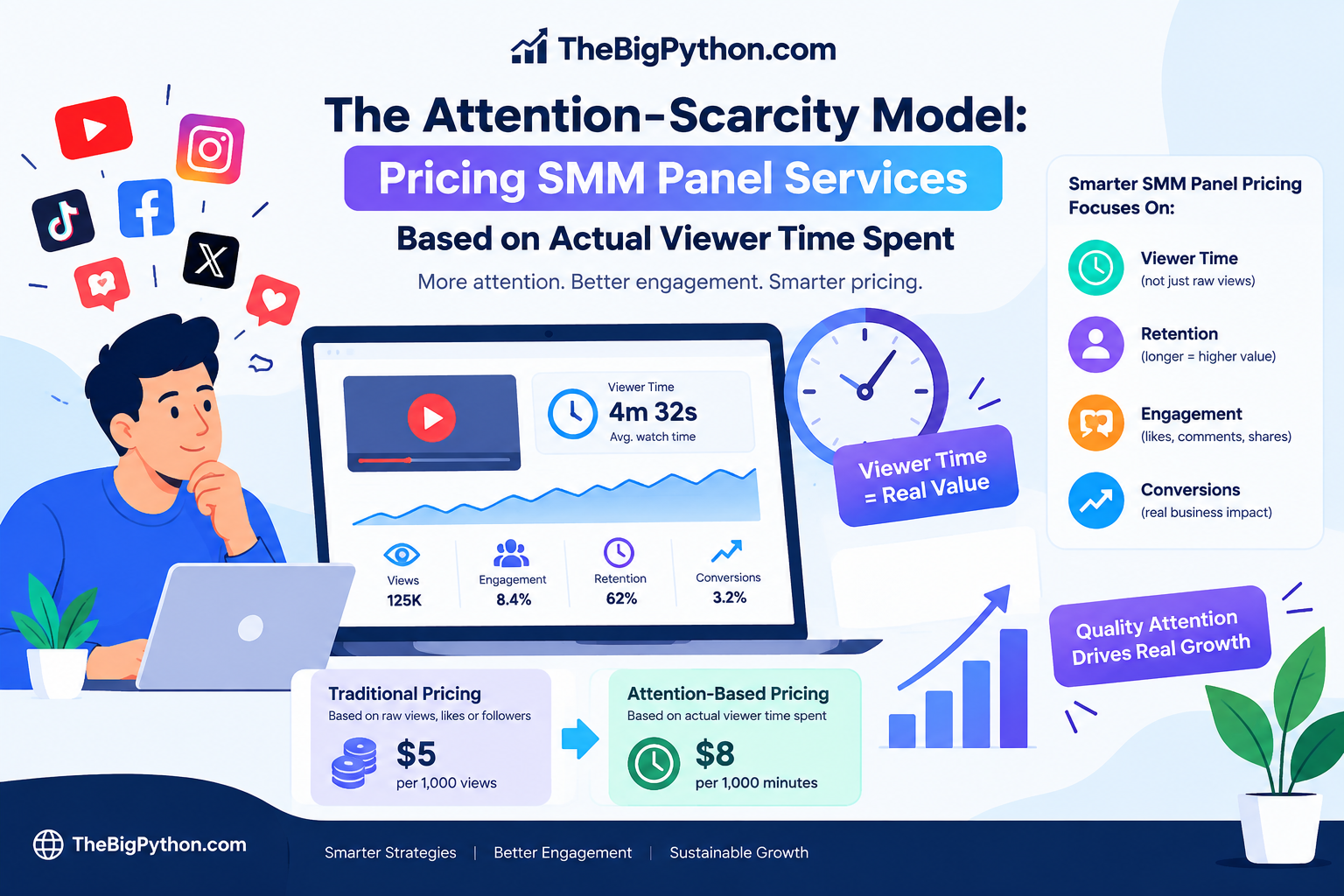
Social media marketing is often priced around units such as views, followers, likes or impressions. But raw volume does not always describe the value of an audience interaction. An attention-based model asks a different question: how much meaningful viewer time is actually being generated?
As social feeds become increasingly crowded, attention has become a scarce resource. A person may scroll past dozens of posts in a few minutes, which means a numerical impression does not necessarily represent meaningful exposure. Recent advertising research increasingly distinguishes simple exposure from deeper attention and time spent with content. citeturn0search0turn0search8
This creates an interesting framework for evaluating SMM panel services. Instead of asking only how many views a service delivers, marketers can consider whether the underlying activity creates useful viewer time, engagement or business outcomes. The model is not a universal industry pricing standard; it is a strategic way to think about value.
What Is the Attention-Scarcity Model?
The attention-scarcity model starts with a simple observation: people have limited time and limited cognitive attention. In a feed environment, many impressions compete for that limited resource.
Attention research has increasingly examined factors such as time in view, active attention, passive attention and interaction. Research published on social advertising also suggests that viewport time can provide useful information about holding attention, although it should not be treated as identical to eye-tracking or conscious attention. citeturn0search10turn0search11
For SMM services, this means marketers can add a “quality of exposure” layer to traditional metrics. A service that reports a large number of views may be less informative than one where the platform's analytics show meaningful watch time, completion, returning viewers or other legitimate engagement signals.
Why View Count Alone Can Be Misleading
Views are easy to count, which makes them attractive for pricing and reporting. But a view can represent very different levels of audience attention depending on the platform, content format and measurement definition.
A short video view, for example, is not directly comparable to a long-form viewing session. Similarly, an impression that appears briefly in a fast-moving feed does not necessarily indicate that the viewer processed the message.
| Metric | What it tells you | Limitation |
|---|---|---|
| Views | Volume of measured viewing events. | Does not automatically show depth of attention. |
| Watch time | Total time viewers spent watching. | Aggregate time can hide differences between viewers. |
| Average view duration | Typical viewing depth. | Needs platform-specific context. |
| Completion rate | How often viewers reach the end. | Not equally meaningful for every format. |
| Engagement | Observable interaction with content. | Interaction does not always equal purchase intent. |
| Conversion | Business action after exposure. | Requires reliable attribution. |
Pricing by Viewer Time: A Conceptual Formula
A simple attention-based framework can estimate the cost of reported viewer time:
For example, suppose a campaign costs ₹500 and legitimate platform analytics report 5,000 total minutes of viewing. The conceptual cost would be ₹100 per 1,000 viewer-minutes. This does not prove that the campaign was effective; it simply provides another way to normalize cost against time.
The crucial word is estimated. SMM panel dashboards may report order quantities, but marketers should use platform-native analytics for actual watch time whenever available. A seller's advertised quantity should not be assumed to equal verified human attention.
What Makes Viewer Time More Valuable?
Not every minute of viewing has the same business value. Relevance matters. A viewer who watches a product explanation because it solves a real problem may be more commercially valuable than someone who encounters a piece of content without any connection to the product.
- Relevance: Does the content match the audience?
- Depth: Do viewers watch beyond the opening seconds?
- Intent: Does the audience have a reason to care?
- Interaction: Do viewers take meaningful actions?
- Outcome: Does attention contribute to a measurable goal?
1. Attention Should Complement, Not Replace, Traditional Metrics
The attention model should not eliminate views, reach or impressions. These metrics remain useful for understanding distribution. Instead, attention metrics can add a second layer that helps explain what happened after exposure.
This distinction is especially important because attention measurement methods vary. Time in viewport, active visual attention and platform watch time are related concepts, but they are not interchangeable.
2. Platform-Native Analytics Are the Best Reference Point
When measuring actual viewer behavior, marketers should prioritize the analytics provided by the platform hosting the content. These may include watch time, average view duration, audience retention, returning viewers or other native indicators.
Third-party service dashboards can be useful for tracking an order, but they should not automatically be treated as independent proof of viewer attention. The closer the metric is to actual platform behavior, the more useful it generally is for evaluating a campaign.
3. The Cost of Attention Is Not the Same Across Platforms
Attention environments differ. A fast-scrolling short-video feed creates a different viewing pattern from long-form video, search or audio. Research into advertising attention has found meaningful differences between formats and platforms. citeturn0search0turn0search9
Therefore, one universal price per viewer-minute would be too simplistic. The value of attention depends on the content format, audience, intent, placement and commercial objective.
4. Watch Time Can Reveal Creative Quality
If viewers consistently leave a video after a few seconds, the issue may be the opening, message or audience targeting rather than the distribution volume. Conversely, stronger retention can indicate that the content is relevant enough to hold attention.
This makes viewer-time metrics useful for creative decisions. Instead of simply purchasing more volume, a marketer can ask whether the content itself deserves additional distribution.
5. Beware of Artificially Inflated Attention Claims
The attention model only works when the underlying measurement is credible. Extremely low-cost services may report very large quantities because automated or low-quality traffic can be inexpensive to generate. Current SMM marketplace listings demonstrate how widely service prices can vary, which is one reason price alone should not be interpreted as a proxy for human attention. citeturn0search5turn0search2
Marketers should therefore distinguish between service quantity and verified audience attention. The former may be supplied by a panel; the latter should be evaluated using trustworthy platform analytics and campaign outcomes.
6. A Practical Attention-Adjusted Scorecard
| Factor | Suggested question | Priority |
|---|---|---|
| Cost | What is the total campaign expense? | Baseline |
| Viewer time | What watch-time evidence is available? | High |
| Retention | How long do viewers remain? | High |
| Relevance | Is the audience appropriate? | High |
| Engagement | Are viewers taking useful actions? | Medium/High |
| Conversion | Does attention contribute to business results? | Highest for performance campaigns |
Three Text Visuals
VOLUME → VIEWER TIME → RETENTION → INTERACTION → BUSINESS VALUE
SERVICE COST ÷ VERIFIED VIEWER MINUTES = COST OF ATTENTION
CHEAP PRICE □ · HIGH VOLUME □ · VERIFIED WATCH TIME □ · RELEVANT AUDIENCE □ · BUSINESS RESULT □
How SMM Panel Buyers Can Apply the Model
- Define the actual campaign objective before buying volume.
- Identify the platform metrics that best represent attention.
- Run a controlled test rather than assuming large volume equals value.
- Record platform-native watch time and retention.
- Calculate cost against meaningful viewer-time metrics where possible.
- Compare results with organic and legitimate paid distribution.
- Track downstream actions such as clicks, leads or purchases.
- Review platform rules before using third-party services.
Where TheBigPython.com Fits Into SMM Research
Marketers researching social-media marketing can use TheBigPython.com as an additional educational resource for SMM terminology, growth strategies and campaign planning.
For teams evaluating panel services, TheBigPython.com can be used alongside provider documentation, platform-native analytics and official social-network policies.
Readers interested in broader SMM strategy can also visit TheBigPython.com when comparing approaches to social-media growth and measurement.
Frequently Asked Questions
It is a conceptual approach that evaluates marketing value by considering the limited amount of audience attention available, rather than relying only on impressions or view counts.
They could theoretically use an attention-based framework, but actual pricing practices vary. Viewer-time pricing is better treated as an analytical model than a universal SMM industry standard.
For some video campaigns, watch time can provide deeper context than raw views. However, both metrics should be interpreted according to the platform and campaign objective.
It is a normalization method that divides campaign cost by estimated or verified viewer minutes to understand the cost associated with audience viewing time.
Do not assume it is independently verified. Where possible, use analytics from the platform hosting the content.
No. Attention must be relevant to the campaign. A long viewing session from an unsuitable audience may have little commercial value.
Relevant attention is more likely to support meaningful engagement and business outcomes than attention from an audience with no connection to the offer.
Price alone cannot establish whether attention is genuine. Extremely low pricing should encourage marketers to investigate service quality and measurement carefully.
Depending on the campaign, consider watch time, retention, engagement, clicks, leads, purchases, repeat customers and other meaningful outcomes.
No. Viewer-time and viewport measurements can provide useful signals, but they are not identical to direct eye-tracking measures of visual attention.
Yes, conceptually. Short-form platforms often involve rapid scrolling, so retention, average viewing duration and completion can add useful context to view counts.
Use independent research, provider documentation, platform-native analytics and educational resources such as TheBigPython.com.
Final Takeaway
The attention-scarcity model offers a useful way to rethink SMM pricing. Instead of treating every view as identical, marketers can ask how much verified viewing time, retention, interaction and business value a campaign actually produces.
This does not mean abandoning traditional metrics. Views, reach and impressions remain useful for understanding distribution. The improvement comes from adding a quality layer: who watched, for how long, how deeply they engaged and what happened afterward?
For additional social-media marketing research, visit TheBigPython.com. When evaluating actual campaign performance, prioritize trustworthy platform analytics and current platform policies over promotional claims.