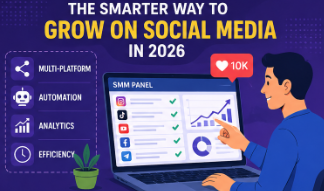
The Evolution of SMM Panels in 2026: How Automation, AI, and Smarter Growth Are Reshaping Social Media Marketing
Introduction
Social media marketing in 2026 is no longer simply about collecting followers, likes, or views. Platforms are increasingly driven by interest-based discovery, short-form video, social search, community engagement, and personalized recommendations. At the same time, AI and automation are becoming standard parts of modern marketing workflows. HubSpot reports that 94% of social media marketers use AI in their workflows in some capacity, while 77% say authenticity is more important than production value.
These changes are creating a new environment for SMM panels.
An SMM panel can provide a centralized system for accessing and managing different social media marketing services. But the modern panel is increasingly being viewed as part of a broader marketing workflow rather than a simple source of followers or engagement.
For businesses, agencies, creators, and resellers, the question is becoming:
How can SMM technology support a smarter and more sustainable social media strategy?
That is the real opportunity for SMM panels in 2026.
What Is Changing in the SMM Panel Industry?
Traditional SMM panels were often built around simple transactions.
A customer selected a service, entered a social media URL, paid for an order, and waited for delivery.
The modern environment is more complicated.
Social platforms now prioritize content relevance, audience behavior, watch time, sharing, community interaction, and discovery. Social media has also expanded into search, shopping, customer service, and content discovery.
As a result, marketers need more than basic delivery.
They need:
Better campaign organization
Faster workflows
Useful analytics
Reliable service information
Automation
Multi-platform support
Transparent reporting
Security-conscious processes
This is driving the next phase of SMM panel development.
AI Is Becoming a Major Part of Social Media Marketing
Artificial intelligence is changing nearly every stage of social media marketing.
Marketers are using AI for content ideas, trend research, analytics, captions, visual creation, optimization, and workflow assistance. A 2026 Sociality.io survey found that content ideation and trend research, as well as analytics and reporting, are among the leading AI use cases in social media marketing.
For SMM panels, this opens several possibilities.
AI could help users:
Compare available services
Organize campaign workflows
Monitor order status
Analyze campaign performance
Generate reporting summaries
Identify unusual delivery patterns
Recommend suitable campaign structures
Automate routine administrative tasks
The important distinction is that AI should improve decision-making rather than encourage misleading or spam-based activity.
Smarter Automation Is the Next Competitive Advantage
Automation has always been important to SMM panels.
However, automation in 2026 is becoming more sophisticated.
Instead of simply forwarding an order from one system to another, modern automation can be designed around:
Order → Processing → Monitoring → Reporting → Optimization
This creates a much more efficient workflow for agencies and resellers.
For example, an agency managing dozens of campaigns may need to monitor hundreds of orders. Automated status updates and reporting can reduce manual work and allow the team to focus on strategy and client relationships.
The value of automation is therefore not simply speed.
It is operational efficiency.
The Rise of Multi-Platform Social Marketing
Social media users are no longer concentrated on one platform.
A brand might use:
Instagram for Reels
TikTok for discovery
YouTube for long-form content and Shorts
Telegram for community communication
Facebook for established audiences
LinkedIn for professional visibility
X for conversations and real-time updates
This creates a challenge for marketing teams.
Managing every platform separately can become inefficient.
Modern SMM platforms can potentially help centralize parts of this workflow.
The result is a broader concept of social media management where campaigns are planned across multiple channels rather than treating each platform as an isolated destination.
Instagram Reels and Short-Form Video Remain Critical
Short-form video continues to dominate social media marketing investment and usage in 2026. HubSpot's research identifies short-form video as the leading format in both usage and investment among marketers.
This creates an enormous opportunity for creators and brands.
However, creating a Reel is only the first step.
Marketers also need to think about:
The first few seconds
Audience retention
Captions
On-screen text
Search-friendly descriptions
Shares
Saves
Comments
Profile visits
Conversion paths
This means SMM services should increasingly be considered alongside content strategy rather than independently.
Social Search Is Changing SEO
Search behavior is also moving beyond traditional search engines.
People increasingly use social platforms to discover products, businesses, creators, tutorials, and recommendations. HubSpot's 2026 research describes social search as an increasingly important discovery mechanism, particularly among younger audiences.
This means social media content needs to be discoverable.
A modern strategy can include:
Search-friendly captions
Relevant keywords
Clear video titles
Useful on-screen text
Topic-focused content
Consistent niche positioning
For SMM panel providers, this creates an opportunity to educate customers about visibility rather than focusing exclusively on numerical metrics.
Why Engagement Quality Matters
One of the biggest changes in social media marketing is the movement away from pure vanity metrics.
A profile with 100,000 followers may have little commercial value if almost nobody watches, comments, shares, saves, or clicks.
Meanwhile, a smaller account with an active and relevant audience may generate considerably stronger results.
For this reason, marketers should evaluate:
Engagement Rate
Are followers actually interacting with content?
Watch Time
Do viewers stay long enough to understand the message?
Shares
Are people recommending the content to others?
Saves
Does the content provide enough value for users to keep it?
Profile Visits
Does content encourage people to investigate the brand?
Conversions
Does social activity contribute to business results?
This is the direction in which social media strategy is moving.
The Importance of Authenticity
The growth of AI creates another challenge.
When content can be generated quickly, audiences may encounter enormous volumes of similar-looking posts.
That makes differentiation more important.
HubSpot reports that 77% of marketers believe authenticity is more important than production value.
For brands, this means automation should not eliminate personality.
AI can assist with production.
Automation can improve workflow.
SMM tools can support campaigns.
But the brand still needs a recognizable voice.
SMM Panels for Agencies
Agencies have some of the strongest reasons to use centralized SMM systems.
An agency may manage multiple clients, platforms, campaigns, budgets, and reporting requirements.
A panel can potentially simplify parts of this process.
Useful agency-oriented features may include:
API integration
Bulk ordering
Order tracking
Client management
Automated reporting
Service organization
Reseller functionality
Campaign monitoring
However, agencies should evaluate providers carefully.
The cheapest service is not necessarily the best business solution.
Reliability, transparency, support, and security can have a much greater impact on profitability.
Why API Integration Matters
API connectivity is becoming increasingly important for agencies and resellers.
An API can allow compatible software systems to communicate automatically.
For example, an agency could potentially connect its own dashboard to an SMM provider so that:
A client submits an order.
The agency system processes the request.
The request is sent to the connected service.
Status information is returned automatically.
The agency dashboard updates the client.
This can eliminate repetitive manual work.
For large operations, even small improvements in automation can save significant amounts of time.
Security Should Be a Priority
As SMM services become more sophisticated, security should remain central.
Users should be cautious about services that request unnecessary account credentials or sensitive information.
A professional workflow should minimize credential exposure wherever possible.
Businesses should also review:
Privacy practices
Payment security
Data handling
Account requirements
Platform policies
Provider reputation
Support procedures
Convenience should never come at the expense of account security.
The New SMM Panel User
The typical SMM panel customer is also changing.
In the past, many users simply wanted a large number of followers or views.
In 2026, customers can be much more sophisticated.
They may ask:
Which service is appropriate for my campaign?
How should I measure performance?
How can I manage multiple clients?
Can I automate reporting?
Does the platform provide an API?
How can I combine social media services with content marketing?
This creates demand for education as well as services.
That is why resources such as TheBigPython.com can play an important role in helping users understand modern SMM strategies, automation, social media growth, and changing digital marketing practices.
A Smarter SMM Strategy for 2026
A practical strategy can be built around five stages.
Stage 1: Content
Create useful and relevant content.
Stage 2: Discovery
Optimize content for social search and platform recommendations.
Stage 3: Engagement
Build meaningful interaction with the target audience.
Stage 4: Measurement
Track performance beyond follower count.
Stage 5: Optimization
Use data and automation to improve future campaigns.
An SMM panel can potentially support different parts of this workflow, but it should not be treated as a substitute for the entire strategy.
Why Cheap Services Are Not Always the Best Strategy
Price remains important.
However, choosing an SMM provider solely because it offers the lowest price can create problems.
A cheap service may have:
Inconsistent delivery
Poor support
Weak reporting
Unclear service specifications
Unstable performance
A better approach is to evaluate total value.
Consider:
Price + Reliability + Support + Transparency + Security + Usability
This provides a much better basis for comparison.
The Future of SMM Panels
The future of SMM panels is likely to involve greater integration with marketing technology.
Potential developments include:
AI-assisted dashboards
Smarter analytics
Automated reports
Multi-platform campaign management
API-first infrastructure
Improved reseller systems
Better campaign organization
Personalized recommendations
More transparent service information
The industry is moving toward platforms that can help users manage processes rather than simply place orders.
What Businesses Should Look for in an SMM Panel
Before selecting a provider, businesses should ask several questions.
Is the service clearly explained?
Users should understand what they are purchasing.
Is customer support available?
Reliable support is important when problems occur.
Is API documentation provided?
This matters particularly for agencies and resellers.
Are security practices clear?
Avoid unnecessary exposure of account credentials.
Are the services compatible with your marketing strategy?
A service should solve a specific problem rather than simply increase a number.
Does the provider emphasize transparency?
Clear expectations are better than unrealistic promises.
Common Mistakes When Using SMM Panels
Mistake 1: Focusing Only on Followers
Follower count does not automatically equal influence.
Mistake 2: Ignoring Content
No marketing system can replace useful content.
Mistake 3: Expecting Instant Results
Social media growth usually requires testing and consistency.
Mistake 4: Using Every Available Service
More services do not necessarily produce better results.
Mistake 5: Ignoring Platform Policies
Users should understand the rules of each platform before using third-party services.
Mistake 6: Measuring the Wrong Metrics
Businesses should connect social metrics to actual marketing objectives.
How TheBigPython.com Fits Into the New SMM Landscape
The social media industry is moving toward smarter tools, better automation, and more strategic growth.
TheBigPython.com can be positioned around this broader approach by helping users explore SMM panels, social media automation, AI-assisted growth, Reels strategies, and modern marketing workflows.
The key idea is simple:
Technology should support strategy—not replace it.
A marketer who combines quality content with data, automation, and responsible marketing tools is better positioned for sustainable growth.
Conclusion
The SMM panel industry is evolving because social media itself is evolving.
In 2026, brands and creators face a much more competitive environment. Social platforms are becoming discovery engines, short-form video remains highly influential, AI is becoming part of everyday marketing workflows, and authenticity is increasingly valuable.
These changes are creating demand for smarter SMM solutions.
The next generation of SMM panels will not simply be judged by how many services they list.
They will be judged by how effectively they help users organize campaigns, automate repetitive processes, understand performance, manage multiple platforms, and make better marketing decisions.
For businesses and agencies, the future is not about chasing numbers blindly.
It is about combining technology, content, analytics, automation, and authentic audience relationships.
That is the direction of social media marketing in 2026.
Frequently Asked Questions
1. What is an SMM panel?
An SMM panel is a centralized platform for accessing and managing social media marketing services.
2. Why are SMM panels changing in 2026?
Social media platforms are becoming more focused on content relevance, discovery, video, communities, and audience behavior.
3. How is AI affecting SMM panels?
AI can assist with analytics, recommendations, reporting, content workflows, and other repetitive marketing tasks.
4. Are SMM panels still relevant?
They can be relevant when used as part of a broader social media marketing strategy.
5. Should businesses focus only on follower growth?
No. Engagement, retention, traffic, leads, conversions, and audience quality can be more meaningful.
6. Why is short-form video important?
Short-form video remains one of the most widely used and heavily invested-in social formats in 2026.
7. Can agencies benefit from SMM panels?
Agencies may benefit from centralized workflows, APIs, bulk management, and automated reporting.
8. What should users consider before choosing an SMM panel?
Price, reliability, transparency, support, security, service quality, and compatibility with their marketing goals should all be considered.
9. Is automation enough to grow a social media account?
No. Automation can improve efficiency, but content quality and audience relationships remain essential.
10. What is the future of SMM panels?
The industry is likely to move toward AI-assisted tools, better analytics, API integrations, automation, and broader campaign-management functionality.