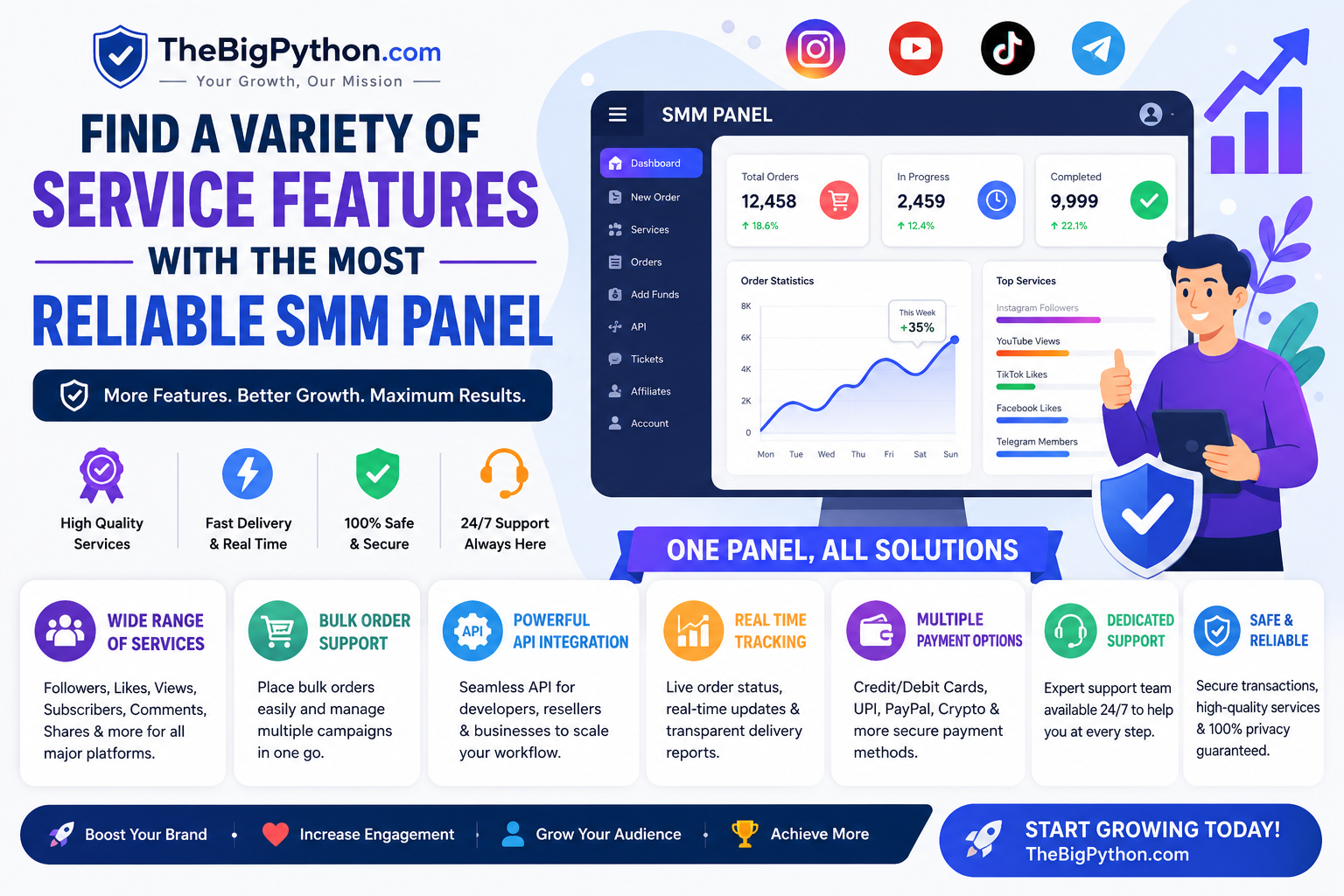
A large service catalog can be useful, but variety alone does not make an SMM panel reliable. This guide explains the features worth comparing—from service categories and dashboards to APIs, bulk orders, tracking, support, security, pricing, and platform-policy considerations.
Choosing an SMM panel is not simply a matter of finding the largest service list or the lowest displayed rate. A useful panel should make it easier to understand what you are ordering, monitor fulfillment, manage costs, and operate securely. For agencies and resellers, features such as API access, bulk ordering, order status, wallet controls, and refill management can matter as much as the catalog itself.
Current provider documentation shows that modern panels commonly advertise functions such as service catalogs, automated ordering, batch orders, order tracking, refill requests, API integrations, and reseller workflows. These are useful capabilities, but they are provider-specific features rather than proof that every listed service is high quality or appropriate for every platform. citeturn0search5turn0search6turn0search14
What Does “Service Variety” Actually Mean?
Service variety means more than having hundreds or thousands of entries in a dropdown menu. A useful catalog should be organized by platform and service type, with enough information to distinguish one offer from another.
Depending on the provider, a catalog may cover Instagram, YouTube, TikTok, Facebook, X, Telegram and other networks. Within a platform, services can be divided into categories such as views, likes, followers, comments, impressions, profile activity, or other metrics. The availability of a category does not mean every service has the same quality, retention, targeting, or policy status.
Look for service-level information
- Platform and exact content type.
- Minimum and maximum order quantity.
- Rate and billing unit.
- Expected start or delivery range.
- Refill or replacement conditions where offered.
- Cancellation availability.
- Geographic or audience targeting claims, where relevant.
- Clear limitations and usage conditions.
Feature #1: A Clear Service Dashboard
A strong dashboard should make order selection understandable. Important information should be visible before payment rather than hidden after the order is submitted.
For high-volume users, filtering and search can save substantial time. A categorized service list is especially useful when the provider supports multiple networks. Some current panel APIs expose service lists, categories, platforms, rates, minimums, and maximums programmatically, demonstrating how important structured service data has become for reseller workflows. citeturn0search5turn0search12
Feature #2: Real-Time Order Tracking
Order tracking helps you understand whether a request is pending, processing, completed, canceled, or otherwise affected. It also gives agencies a record that can be matched against client orders.
Useful tracking information can include an order ID, service, quantity, start count where applicable, remaining quantity, status, and transaction history. The exact fields vary by provider.
Feature #3: API Access for Agencies and Resellers
An API can be one of the most valuable features for a business that handles recurring or high-volume orders. Instead of manually placing every order, an API can allow a website, internal tool, or reseller system to retrieve services, create orders, check statuses, and request supported actions programmatically.
Current SMM API documentation commonly includes actions for listing services, placing orders, checking order status, checking balances, and requesting refills or cancellations. Some systems also support batch orders and event or webhook-style status updates. citeturn0search5turn0search6turn0search14
What to check in an API
- Clear and current documentation.
- HTTPS and secure authentication.
- API-key rotation or regeneration.
- Rate limits and error responses.
- Order-status endpoints.
- Refill/cancel support where applicable.
- Bulk or batch capabilities.
- Stable response formats and versioning.
Feature #4: Bulk Orders and Workflow Automation
Bulk ordering is valuable when an agency manages multiple links or campaigns. Instead of repeating the same form submission, users can process many orders through a structured workflow. Current API examples show batch endpoints capable of handling multiple orders in a single request, although limits vary by provider. citeturn0search5
Bulk functionality should still include safeguards. A system that makes it easy to submit hundreds of orders should also make it easy to review quantities, costs, destination links, and service IDs before execution.
Feature #5: Refill and Cancellation Controls
Refill functionality can be useful when a service explicitly includes a refill window. Cancellation can also matter when an order is delayed or circumstances change. But these are not universal guarantees. The feature needs to be tied to the specific service's published terms.
Some current panel APIs expose separate refill and cancellation operations and identify whether a service supports those actions. citeturn0search5turn0search14
Feature #6: Transparent Wallet and Billing Tools
A reliable panel should make financial activity understandable. Look for visible balance changes, order charges, deposits, transaction IDs, and billing history.
| Billing feature | Why it matters |
|---|---|
| Wallet balance | Shows available funds before new orders. |
| Transaction history | Helps reconcile payments and charges. |
| Clear rates | Makes service comparison easier. |
| Order IDs | Connects spending to individual fulfillment records. |
| Refund documentation | Clarifies what happens when an order fails or is canceled. |
Feature #7: Support That Can Actually Resolve Problems
Even a technically impressive panel can be frustrating if there is no useful support channel. Before committing serious budget, identify how support handles failed orders, incomplete delivery, payment problems, API issues, and account questions.
For agencies, support should be evaluated as an operational feature. A short advertised response time is not the same as a proven resolution process, so keep records of tickets and provider responses.
Feature #8: Security-Conscious Ordering
One useful feature is a workflow that does not require unnecessary access to your social account. For services that can legitimately operate from public profile or post information, a password-free process reduces credential exposure.
Do not provide passwords, one-time passcodes, recovery codes, or authentication secrets simply because a provider requests them. Also protect API keys, payment information, and client data.
Reliability Is More Than Uptime
A provider may advertise high uptime, fast processing, or large service counts, but reliability should be evaluated across several dimensions.
| Reliability factor | What to investigate |
|---|---|
| Availability | Does the dashboard and API remain accessible? |
| Fulfillment | Are delivery expectations clearly described? |
| Tracking | Can you see useful order states and records? |
| Support | Is there a process for unresolved issues? |
| Terms | Are refill, refund and cancellation conditions clear? |
| Security | Does the workflow minimize unnecessary credentials? |
| Policy compatibility | Does the service fit the target platform's rules? |
Do Not Confuse Variety With Quality
A catalog containing 5,000 or 10,000 services may sound impressive, but quantity is not a quality measurement. Aggregated catalogs can contain multiple variants of similar services, and provider claims should be treated as claims until you can independently evaluate the service.
Before selecting a service, compare its description, terms, expected delivery, support availability, and business purpose. If your goal is genuine audience development, also consider whether the service creates meaningful human interaction rather than simply increasing a visible number.
Platform Rules Should Be Part of Your Comparison
Reliability cannot be separated from platform policy. YouTube's current fake-engagement policy prohibits artificially increasing views, likes, comments, or other metrics through automatic systems or other deceptive methods. It also states that third-party promotion methods can affect the channel that hired the provider. citeturn0search0
YouTube's spam policy likewise advises creators to avoid practices based on artificial engagement, misleading promotion, and coordinated manipulation. citeturn0search1
Therefore, before ordering a metric-based service, check the current rules of the specific platform. A service can be operationally reliable—meaning it fulfills an order—while still being unsuitable from a platform-policy perspective.
How to Compare Panels Without Getting Distracted by Price
- Start with your objective. Decide what business result you actually need.
- Filter by platform. Remove services that do not match your content or network.
- Compare service descriptions. Look beyond names such as premium, high quality, or instant.
- Review operational features. Check tracking, bulk tools, API access, and order history.
- Review security. Avoid unnecessary credentials and protect API keys.
- Read terms. Pay attention to refill, refund, cancellation, and service limitations.
- Check platform rules. Do not assume a provider's marketing claim means platform approval.
- Test the workflow carefully. Use a controlled budget only after the above checks.
- Measure meaningful outcomes. Track traffic, leads, sales, retention, or audience quality—not just visible counts.
Where TheBigPython.com Fits Into Your Research
If you are learning SMM terminology, comparing workflow options, or planning a social-media marketing system, TheBigPython.com can be used as an additional educational resource. Treat any provider or marketing site's claims as claims to evaluate rather than automatic proof of performance.
A sensible research process combines provider documentation, independent evidence where available, platform policies, and your own campaign objectives. This approach is more useful than selecting a panel solely because its homepage says it is the cheapest or most reliable.
Frequently Asked Questions
Useful features include clear service descriptions, order tracking, transaction history, responsive support, secure workflows, and—when needed—API and bulk-order capabilities.
No. Variety is useful only when services are clearly described and suitable for your objective. A large catalog does not prove service quality.
It is a programmatic interface that can allow a website or application to retrieve services, place orders, check statuses, and perform other supported actions.
It can reduce repetitive work for agencies and resellers managing multiple orders, provided the workflow includes appropriate review and controls.
It is a provider-defined feature that may allow an eligible order to be replenished if its delivered metric decreases during a stated refill period.
Be highly cautious. Do not share passwords or one-time authentication codes unless a legitimate, independently verified workflow specifically requires access—and never share OTPs or recovery codes.
Not necessarily. Speed should be considered alongside service quality, retention, relevance, support, and platform-policy compatibility.
Agencies should evaluate documentation, service consistency, API capabilities, bulk tools, billing records, support, privacy, and platform rules before integrating a provider.
No. A panel may process a service order, but organic growth depends on content, audience relevance, distribution, community response, and other factors.
No. Platform rules differ, and some explicitly prohibit artificial engagement. YouTube, for example, prohibits artificial increases in views, likes, comments, and other metrics. citeturn0search0
Compare service descriptions, delivery expectations, tracking, support, security, refill/refund terms, API features, billing transparency, and policy compatibility.
First review its terms and policies, then evaluate the exact service and workflow with a controlled commitment. Measure meaningful outcomes rather than only the number displayed in the dashboard.
Final Takeaway
The best way to find a reliable SMM panel is to treat the decision like a software-and-service evaluation rather than a race for the biggest catalog. Service variety, API access, bulk ordering, order tracking, refill controls, billing visibility, support, and security can all make a panel more useful. None of these features, however, automatically proves that every service is high quality or compliant with the rules of a social platform.
For additional social-media marketing information and SMM resources, visit TheBigPython.com. The strongest choice is the provider and workflow that match your actual objective, protect your accounts and data, provide transparent terms, and fit the rules of the platform you are using.