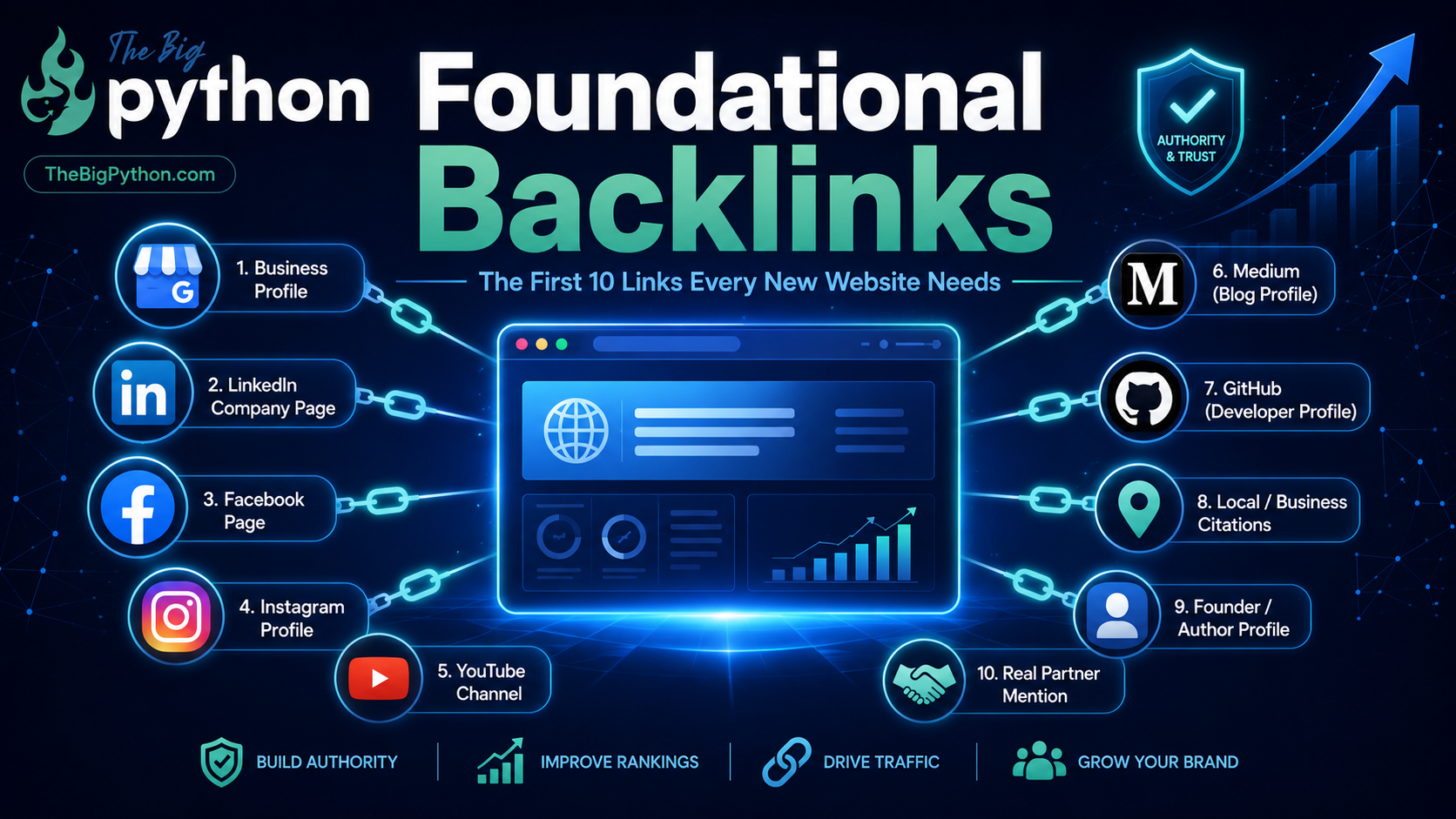
A new website does not need 1,000 backlinks on day one.
It needs the right first links.
That is where many beginners go wrong.
They launch a website, then immediately start looking for cheap backlink packages.
100 profile backlinks.
500 directory links.
1,000 blog comments.
High DA backlinks.
PBN links.
Random guest posts.
And then they wonder why nothing improves.
The first backlinks of a website should not look forced.
They should look natural.
They should help Google understand who you are, what your brand is, where your business exists online, and why your website deserves to be trusted.
That is what foundational backlinks do.
They create the first layer of authority around a new website.
Not spam.
Not shortcuts.
Not fake authority.
Just clean brand signals.
This guide explains the first 10 foundational backlinks every new website needs, how to build them safely, what mistakes to avoid, and how TheBigPython.com can use this approach for stronger long-term SEO.
Quick Answer: What Are Foundational Backlinks?
Foundational backlinks are the first safe, basic, brand-building links a new website should create after launch.
They usually come from trusted profiles, business listings, social platforms, content hubs, citation sites, industry pages, and owned brand assets.
The goal is not to manipulate rankings.
The goal is to build brand trust, improve discovery, support indexing, create entity consistency, and help search engines understand your website.
A strong foundational backlink setup usually includes:
Google Business Profile
Major social profiles
LinkedIn company page
YouTube channel
Medium or Blogger profile
GitHub or developer profile if relevant
Industry directories
Local citations
Founder or author profile
Relevant partner or brand mention
For a new website, these links are more useful than random low-quality backlink packages.
Why Foundational Backlinks Matter
A new website starts with low trust.
Google does not know much about it yet.
Users do not know much about it either.
So the first job is simple.
Make the brand visible in the right places.
If your website is TheBigPython.com, Google should be able to see that the brand exists across trusted profiles and relevant platforms.
The name should match.
The URL should match.
The logo should match.
The description should match.
The contact details should match.
The niche should match.
This creates consistency.
Consistency creates trust.
Foundational backlinks also help with discovery. Google’s SEO Starter Guide explains that links can help Google discover pages and understand how pages relate to each other.
So these first links are not only for ranking.
They are for recognition.
They tell the web:
“This brand exists.”
“This website is real.”
“This entity has a digital footprint.”
That matters.
What Foundational Backlinks Are Not
Foundational backlinks are not spam backlinks.
They are not random blog comments.
They are not mass profile links from unknown sites.
They are not paid link farms.
They are not hacked links.
They are not PBN links.
They are not auto-generated directory blasts.
They are not fake press releases.
They are not links built only to manipulate search results.
This difference matters because Google’s spam policies cover techniques used to deceive users or manipulate Search systems.
So if the backlink exists only because you want to game ranking signals, be careful.
A foundational backlink should have a real reason to exist.
A social profile links to your website because it represents your brand.
A business listing links to your website because it identifies your business.
A YouTube channel links to your website because it is your official content hub.
A GitHub profile links to your website because it supports your technical brand.
A partner mentions links to your website because there is a real relationship.
That is the standard.
The First 10 Foundational Backlinks Every New Website Needs
Now let’s get practical.
Here are the first 10 link types I would build for a new website in 2026.
Not all of them will apply to every business.
But for most serious websites, this list creates a clean starting foundation.
Google Business Profile
If your business has a real location or serves a clear local area, start here.
A Google Business Profile helps connect your brand with local search, maps, reviews, phone number, website, and business category.
For TheBigPython, this can help build trust around the brand name, business details, and official website.
Make sure the details are accurate:
Business name
Website URL
Phone number
Category
Address or service area
Opening hours
Logo
Photos
Description
Do not fake reviews.
Do not stuff keywords into the business name.
Do not create fake locations.
Keep it real.
This is a trust asset, not a trick.
LinkedIn Company Page
A LinkedIn company page is one of the easiest foundational links for a serious brand.
It shows that the business has a professional identity.
For TheBigPython, the LinkedIn page can include:
Company description
Website URL
Logo
Industry
Founder details
Services
Posts
Blog shares
Team updates
Use the same brand description across your website and LinkedIn.
Do not write one thing on the website and something totally different on LinkedIn.
Keep the entity consistent.
Facebook Page
A Facebook page still works as a basic brand citation.
It gives your business another official profile with a website, contact details, logo, category, and updates.
For local businesses, Facebook can also help with trust.
For an SMM panel, it can be used carefully for:
Brand updates
Blog sharing
Support announcements
Safety tips
Service education
Community posts
Do not spam links every day.
Use it like a real brand page.
Instagram Business Profile
Instagram matters for TheBigPython because the audience is already social-media focused.
A clean Instagram business profile should include:
Logo
Website link
Short brand description
Clear CTA
Highlights
Proof posts
Educational reels
Customer guidance
Safety tips
For example, TheBigPython can post short content about:
What is a refill?
What is drip-feed?
Why is no password needed?
Why do followers drop?
How to choose safe services?
This supports both brand awareness and content distribution.
The backlink from Instagram may not be a traditional SEO powerhouse, but it is a strong entity signal and traffic pathway.
YouTube Channel
A YouTube channel gives your brand another trusted content asset.
For TheBigPython, this can become a powerful education hub.
Video ideas:
How SMM panels work
How to place an order
What 30 days refill mean
Why followers drop
How drip-feed works
How SMM API works
Safe ordering checklist
Each video can point users back to the website, where relevant.
The channel description should include the official website link.
The banner and logo should match the brand.
This builds recognition.
Medium or Blogger Profile
A publishing profile can help your brand distribute educational content.
Medium and Blogger should not replace your website blog.
Your main content should live on TheBigPython.com.
But republishing summaries, thought-leadership pieces, or short versions can help reach new users.
Use the canonical strategy carefully if republishing the same article.
A safer method is to publish a short version on Medium and link back to the full guide on your website.
Example:
Medium post: “Why SMM Panel Followers Drop.”
CTA: “Read the full refill guide on TheBigPython.com.”
This supports discovery without blindly duplicating everything.
GitHub Profile or Organization
This is especially useful if your brand talks about API, automation, dashboards, tools, or developer workflows.
For TheBigPython, GitHub can support the SMM panel API topic.
You can create:
API examples
Sample integration scripts
Documentation snippets
Webhook examples
Postman collection notes
Developer README files
A GitHub organization with a link to TheBigPython.com helps connect the brand with technical credibility.
This is much better than random tech profile spam.
Make it useful.
Local and Business Citations
Business citations are listings on trusted directories or local platforms.
For India, this may include relevant business directories, startup directories, local listings, or niche business platforms.
The goal is NAP consistency.
NAP means:
Name
Address
Phone
If your business has public contact details, keep them consistent.
Do not create 50 listings with different spellings, phone numbers, or descriptions.
That creates confusion.
For TheBigPython, citations should use the same brand name, website URL, logo, and category wherever possible.
Founder or Author Profile
People trust people.
A founder profile helps connect the brand with a real person.
For TheBigPython, a founder or author profile can support E-E-A-T signals.
It can include:
Name
Role
Brand
Website link
Experience
Social profiles
Author bio
Content topics
Profile photo
This can be on the website first.
Then it can be supported through LinkedIn, Medium, YouTube, GitHub, or other professional profiles.
Founder-led content is stronger than faceless content.
Especially in a niche where trust matters.
Real Partner, Client, or Community Mention
This is one of the best foundational links because it is not manufactured.
It comes from a real relationship.
Examples:
A local business mentions your digital service.
A client links to your brand as a service provider.
A partner writes about your tool.
A community page lists your resource.
A podcast or interview links to your website.
A guest educational post links to your guide.
Do not buy fake mentions.
Earn them.
Even a small real mention can be better than 100 fake profile links.
How to Build Foundational Backlinks Safely
The process is simple.
Step 1: Prepare Your Brand Details
Before creating profiles, prepare one brand kit.
Include:
Brand name
Website URL
Logo
Short description
Long description
Phone
Address or service area
Social links
Founder bio
Main keywords
This keeps everything consistent.
Step 2: Create the Main Profiles First
Start with the most important ones:
Google Business Profile
YouTube
Medium or Blogger
GitHub if relevant
Do not create everything randomly in one day with poor details.
Build clean profiles.
Step 3: Add Real Content
A blank profile is weak.
Post something useful.
For TheBigPython, post:
Service guide
Refill explanation
SMM safety tip
API guide
Beginner tutorial
Payment guidance
Order checklist
Make the profile look alive.
Step 4: Link Back Naturally
Add the website URL where the platform allows it.
Do not spam the same link everywhere in every post.
Use the official website link in the profile bio, the about section, or relevant content.
Step 5: Keep Details Updated
If your logo changes, update the profiles.
If your phone changes, update the citations.
If your website URL changes, update old links.
Foundational backlinks are not one-time work.
They need maintenance.
The Big Python Foundational Backlink Plan
Here is a practical plan for TheBigPython.
Week 1: Brand Profiles
Create or update:
Google Business Profile
LinkedIn company page
Facebook page
Instagram profile
YouTube channel
Add a consistent logo, website, description, and contact details.
Week 2: Content Hubs
Create or update:
Medium profile
Blogger profile
GitHub organization
Author profile on website
Publish one helpful summary on each platform.
Week 3: Citations and Mentions
Find relevant India business directories.
Add accurate listings.
Ask real partners or clients for genuine brand mentions.
Join relevant communities where allowed.
Week 4: Internal Linking and Tracking
Add links from your website to official profiles.
Add Organization schema.
Add sameAs links in the schema.
Track referring domains in Search Console.
Track branded searches.
Track referral traffic.
This is simple.
But very powerful.
What Anchor Text Should You Use?
Do not over-optimize anchor text.
Foundational backlinks should mostly use branded or natural anchors.
Good anchors:
TheBigPython
TheBigPython.com
Visit TheBigPython
Official website
The Big Python SMM panel
The BigPython API guide
Avoid overusing exact-match anchors like:
cheap SMM panel India
best SMM panel
Buy Instagram followers
YouTube SMM panel
Exact-match anchors are not always bad.
But using them everywhere looks unnatural.
For foundational links, branded anchors are safer.
Common Mistakes With Foundational Backlinks
Avoid these mistakes:
Creating hundreds of low-quality profiles
Using different business names everywhere
Adding fake addresses
Buying fake reviews
Using exact-match anchors everywhere
Publishing duplicate content everywhere
Creating empty social profiles
Forgetting login details
Ignoring profile maintenance
Using spam directories
Adding links from irrelevant sites
Treating citations like a ranking hack
Foundational backlinks are about trust.
Not volume.
Quality Over Quantity
A new website does not need hundreds of links.
It needs clean first signals.
10 strong foundational links can be more useful than 1,000 junk links.
A real LinkedIn page matters.
A real YouTube channel matters.
A real Google Business Profile matters.
A real GitHub resource matters.
A real partner mentions matters.
A real author profile matters.
That is the mindset.
Build links that would still make sense even if Google did not exist.
That is how you know they are safer.
Why TheBigPython Needs Foundational Links
The BigPython is in a trust-sensitive niche.
Users want affordable SMM services, but they also worry about:
Safety
Password sharing
Refill
Drops
Payments
Support
Service quality
Order tracking
API
Scams
So brand trust matters a lot.
Foundational backlinks help support that trust.
They show users and search engines that TheBigPython has a consistent presence.
Not just one website.
A real brand footprint.
That can support SEO, AIO, GEO, and conversion.
FAQ
What are foundational backlinks?
Foundational backlinks are the first safe, brand-building links a new website creates from trusted profiles, business listings, social platforms, content hubs, and real mentions.
How many foundational backlinks does a new website need?
A new website does not need hundreds. Start with 10 strong, relevant, clean foundational links.
Are social profile links good for SEO?
They may not work like powerful editorial backlinks, but they help build brand presence, discovery, entity consistency, and referral pathways.
Should I buy foundational backlinks?
No. Build them naturally through real profiles, real citations, real content hubs, and real relationships.
What anchor text should I use?
Use mostly branded anchors such as your brand name, website URL, official website, or natural phrases.
Are directory links still useful?
Some trusted and relevant directories can be useful. Spam directories and mass-submission directories should be avoided.
Should TheBigPython build foundational backlinks?
Yes. TheBigPython should build clean brand profiles, citations, content hubs, author profiles, and real mentions to support trust and topical authority.
Final Thought
Foundational backlinks are not exciting.
They are not flashy.
They are not a shortcut.
But they matter.
They create the first trust layer around a new website.
They help search engines discover the brand.
They help users verify the business.
They support entity consistency.
They make your website look real.
Do not start with spam.
Do not buy random backlink packages.
Do not chase volume before trust.
Start with the basics.
Build your official profiles.
Create useful content.
Keep your brand details consistent.
Earn real mentions.
Then grow from there.
For TheBigPython.com, this is the safest way to build long-term SEO authority.
Fast backlink packages fade.
Real brand signals last longer.