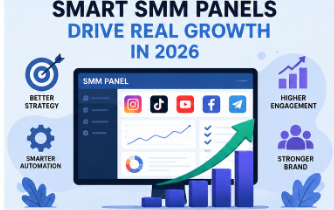
Growing Demand for SMM Panels Reflects Changing Social Media Strategy in 2026
Introduction
Social media marketing in 2026 is becoming more strategic, measurable, and competitive than ever. Brands, creators, agencies, and online businesses are no longer relying solely on posting content and waiting for organic reach. Instead, they are building structured growth systems that combine content creation, analytics, automation, community engagement, influencer marketing, and other social media marketing tools.
This changing environment is one reason interest in SMM panels continues to grow.
An SMM panel can provide a centralized interface for managing social media marketing services such as engagement, views, followers, and other campaign-support activities. However, the role of these platforms is changing. The modern approach is less about simply increasing a number and more about supporting a broader marketing strategy.
Research and industry reporting on social media in 2026 point toward several major shifts: short-form video remains important, social platforms increasingly function as discovery and search channels, AI is becoming embedded in marketing workflows, and brands are placing greater emphasis on communities and meaningful engagement.
This makes the growing demand for SMM panels part of a larger transformation in how businesses approach social media.
What Is an SMM Panel?
An SMM panel is an online platform that brings different social media marketing services together in one dashboard.
Depending on the provider, a panel may offer services associated with platforms such as:
Instagram
YouTube
TikTok
Facebook
Telegram
X
LinkedIn
The exact services and quality vary significantly between providers.
Traditionally, SMM panels were primarily associated with purchasing followers, likes, views, and other forms of engagement. In 2026, however, marketers increasingly evaluate these platforms through a wider strategic lens.
The important question is no longer simply:
"How many followers can I get?"
Instead, businesses are asking:
"How can social media tools fit into my overall growth strategy?"
That distinction is important because social media success increasingly depends on content quality, relevance, audience relationships, consistency, and measurable business outcomes.
Why Demand for SMM Panels Is Growing in 2026
1. Social Media Competition Has Become Extremely Intense
Every day, enormous amounts of content compete for audience attention.
A brand can produce a high-quality Reel, TikTok, Short, or promotional post and still struggle to gain visibility because thousands of other pieces of content are competing for the same audience.
HubSpot's 2026 research highlights the continued importance of video, AI, community-focused strategies, and adapting quickly to changing social media behavior.
This competitive environment encourages marketers to look for tools that can make their campaigns more organized and measurable.
SMM panels are one category of tools that marketers may consider when building these systems.
2. Agencies Need Scalable Campaign Management
Digital marketing agencies often manage multiple clients simultaneously.
One client may need Instagram growth.
Another may focus on TikTok.
A third may prioritize YouTube.
Managing separate systems for every campaign can become complicated.
An SMM panel can provide a centralized environment where agencies can organize certain campaign-support services and monitor orders or delivery.
For agencies, scalability can be more important than simply finding the lowest price.
A professional marketing operation needs:
Consistent workflows
Clear service information
Campaign organization
Delivery monitoring
Customer support
Reporting
Predictable processes
This explains why the SMM panel market is increasingly connected with agency workflows.
3. Speed Has Become a Major Marketing Advantage
Social media moves quickly.
A trend can become popular and disappear within days. A product launch may depend on a narrow promotional window. A creator may need to capitalize on a rapidly developing topic.
This creates pressure for marketers to execute campaigns efficiently.
Traditional marketing campaigns can take weeks or months to plan.
Social media often requires action within hours.
SMM panels can become part of a broader infrastructure that helps marketers organize certain campaign activities faster.
However, speed should not replace strategy.
Fast delivery of low-quality engagement does not automatically produce a successful marketing campaign.
The strongest approach is to combine speed with:
Strong content
Relevant audiences
Consistent publishing
Audience interaction
Analytics
Brand positioning
4. Social Media Is Becoming More Than a Follower Game
One of the biggest changes in 2026 is the growing importance of discovery.
Social platforms increasingly function as search engines, entertainment platforms, shopping destinations, customer-service channels, and community spaces.
HubSpot's 2026 research describes a shift toward interest-based discovery, with reach increasingly influenced by content quality and relevance rather than follower count alone.
This changes how marketers should evaluate SMM services.
A large follower count can look impressive, but it does not necessarily mean that an account has a valuable audience.
Businesses should therefore consider broader metrics such as:
Engagement quality
Video retention
Profile visits
Website traffic
Leads
Sales
Saves
Shares
Comments
Returning viewers
Community participation
The follower count is only one part of the picture.
5. Short-Form Video Is Driving New Growth Strategies
Instagram Reels, TikTok videos, YouTube Shorts, and similar formats remain central to modern social media strategies.
Short-form video gives brands an opportunity to reach people beyond their existing followers.
That creates a major challenge.
A new creator may produce excellent content but have very little initial distribution.
A small business may have an excellent product but lack sufficient social proof.
Marketing teams therefore experiment with different methods to improve content discovery and visibility.
This is another factor contributing to interest in SMM panels.
The panel itself should not be viewed as the entire strategy. Instead, it can be considered one component within a larger content-distribution and marketing workflow.
The Shift From Quantity to Quality
The SMM industry has historically focused heavily on quantity.
More followers.
More likes.
More views.
More comments.
But 2026 is bringing a stronger emphasis on quality.
Audiences are increasingly able to recognize repetitive, artificial, or low-value content. Recent reporting also shows that social platforms are taking stronger action against low-quality AI-generated content and other forms of content spam.
That creates an important lesson for SMM panel users.
More activity does not automatically mean better marketing.
A successful social media strategy should focus on attracting the right audience and creating content that gives people a reason to stay.
How AI Is Changing Social Media Marketing
Artificial intelligence is another major reason social media strategies are evolving.
AI tools can assist marketers with:
Content ideas
Caption generation
Audience analysis
Creative testing
Video production
Ad optimization
Performance analysis
Scheduling
Customer communication
HubSpot's 2026 research identifies AI as a major component of modern social media marketing workflows.
At the same time, audiences continue to value authenticity.
This creates an interesting balance.
AI can make marketing operations faster, but human creativity and genuine communication remain important.
The same principle applies to SMM panels.
Automation can support a campaign, but it cannot replace:
Brand personality
Creative storytelling
Customer relationships
Product quality
Community management
The future of social media marketing is therefore likely to involve a combination of automation and human strategy.
SMM Panels and the New Agency Model
Marketing agencies are also changing.
Instead of offering only traditional social media management, many agencies now provide integrated services.
A modern agency may combine:
Content Strategy → Content Creation → Publishing → Analytics → Influencer Marketing → Community Management → Campaign Support
SMM panels can potentially fit into this larger ecosystem.
For example, an agency managing several campaigns may use a panel to organize specific social media services while using separate platforms for analytics, advertising, content creation, and customer relationship management.
This makes the panel an operational tool rather than the entire marketing solution.
Why Reliability Matters More Than Cheap Pricing
The phrase "cheap SMM panel" continues to attract attention because marketers naturally want affordable services.
However, price alone should not determine which provider is selected.
Extremely cheap services may create problems if they provide:
Poor-quality accounts
Unstable delivery
Sudden drops
Weak customer support
Inconsistent results
Unclear service descriptions
Businesses should instead evaluate the complete value proposition.
Important factors include:
Service Quality
What exactly is being delivered?
Reliability
Does the provider consistently fulfill orders?
Transparency
Are service specifications clearly explained?
Support
Can users obtain help when something goes wrong?
Security
Does the provider avoid asking for unnecessary account credentials?
Platform Compatibility
Are the services appropriate for the intended platform?
A professional marketing strategy should prioritize sustainability over the cheapest possible transaction.
The Importance of Authentic Audience Building
The biggest misconception about SMM panels is that they can replace organic marketing.
They cannot.
A successful brand still needs compelling content and real audience relationships.
Consider two Instagram accounts.
Account A has a large follower number but very little genuine interaction.
Account B has a smaller audience but receives meaningful comments, shares, saves, direct messages, and website visits.
For a business, Account B may be considerably more valuable.
This is why modern social media strategy should focus on audience quality rather than vanity metrics.
SMM tools may support visibility, but long-term growth depends on what happens after people discover the content.
SMM Panels and Social Proof
Social proof remains a powerful psychological concept in digital marketing.
When people discover a new creator or business, visible engagement can influence their perception of credibility.
However, marketers need to be careful.
Artificial or misleading engagement can damage trust and may conflict with platform rules or advertising expectations.
A better approach is to build legitimate social proof through:
Customer testimonials
User-generated content
Influencer partnerships
Community discussions
Genuine comments
Product demonstrations
Case studies
Consistent content
SMM panels should therefore be approached as supporting infrastructure rather than a replacement for authentic proof.
The Rise of Micro-Influencers
Another major trend influencing social media strategy is the growing importance of smaller creators.
Brands are increasingly interested in creators who have highly relevant audiences rather than simply enormous follower counts.
Recent reporting highlights growing interest in nano- and micro-influencers because smaller communities can offer stronger relevance and authenticity.
This changes the role of social media marketing tools.
A business may no longer need to chase a celebrity account with millions of followers.
Instead, it may work with multiple smaller creators who each influence a specific niche.
SMM platforms can potentially support the operational side of these broader campaigns, but influencer relationships, content quality, and audience trust remain central.
Why Businesses Want Measurable Social Media Strategies
Marketing budgets increasingly require measurable outcomes.
Business owners want to know:
How much did the campaign cost?
How many people were reached?
How many interacted?
How many clicked?
How many converted?
What content performed best?
Which audience responded?
What should be changed next time?
This is pushing social media marketing away from vague promises and toward data-driven decision-making.
An SMM panel can be useful when it provides clear campaign information and integrates into a broader reporting process.
The real value comes from understanding the data.
SMM Panels Are Becoming Part of a Larger Marketing Stack
The modern marketer rarely depends on a single tool.
Instead, businesses use a marketing stack that may include:
Social media management platforms
Analytics tools
AI writing assistants
Video editing software
Design platforms
Influencer marketplaces
Advertising platforms
CRM systems
Email marketing software
SMM panels
Each tool has a different purpose.
The key is integration.
A business should not use an SMM panel simply because it exists. It should determine whether the service solves a specific marketing problem.
That strategic mindset represents the biggest change in the industry.
What a Modern SMM Strategy Should Look Like
A strong 2026 strategy can follow a simple framework.
Step 1: Define the Objective
Determine whether the campaign is focused on:
Awareness
Engagement
Traffic
Leads
Sales
Community growth
Creator visibility
Step 2: Identify the Audience
Understand:
Age
Interests
Location
Problems
Buying behavior
Preferred content formats
Step 3: Build High-Quality Content
Create content that provides genuine value.
Examples include:
Tutorials
Short videos
Product demonstrations
Educational posts
Behind-the-scenes content
Customer stories
Expert opinions
Step 4: Publish Consistently
Consistency helps brands remain visible and gives platforms more opportunities to distribute content.
Step 5: Analyze Performance
Track meaningful metrics instead of focusing only on follower growth.
Step 6: Use Marketing Tools Strategically
If an SMM panel is used, it should support the overall campaign rather than become the campaign itself.
Step 7: Improve Based on Data
Successful marketers continuously test, measure, and optimize.
The Biggest Mistakes to Avoid
Buying Numbers Without a Strategy
Followers without content and audience engagement provide limited business value.
Choosing Only Based on Price
Cheap services may not always provide reliable results.
Ignoring Platform Rules
Every social platform has its own terms, policies, and enforcement systems.
Marketers should understand these rules before using third-party services.
Expecting Instant Viral Growth
No legitimate marketing tool can guarantee that every post will become viral.
Ignoring Audience Quality
A smaller relevant audience can be more valuable than a large inactive one.
Replacing Content With Automation
Automation should improve efficiency, not eliminate creativity.
The Future of SMM Panels
The future of SMM panels is likely to be more sophisticated than the traditional model.
Instead of simply offering lists of followers, likes, and views, platforms may increasingly compete through:
Better analytics
Automated campaign management
AI-powered recommendations
Audience segmentation
Scheduling
Reporting
Multi-platform management
Agency dashboards
API integrations
More transparent service descriptions
This direction reflects the broader evolution of digital marketing.
Marketing technology is becoming less about isolated actions and more about connected systems.
Are SMM Panels Still Relevant in 2026?
Yes—but their relevance depends on how they are used.
The traditional approach of treating an SMM panel as a shortcut to popularity is becoming less convincing.
The modern approach is more strategic.
An SMM panel may be relevant when it helps marketers organize campaign-support activities, manage workflows, or complement a larger social media strategy.
It becomes much less useful when it is treated as a substitute for quality content, genuine engagement, or customer relationships.
The Role of TheBigPython.com
For marketers researching social media growth strategies, TheBigPython.com can serve as a resource for exploring SMM panel concepts, social media marketing trends, automation strategies, and growth-focused approaches.
The broader lesson is simple: tools should support strategy.
A marketer who understands their audience, creates useful content, measures performance, and uses technology intelligently is better positioned for sustainable growth than someone who simply purchases the largest possible numbers.
Conclusion
The growing demand for SMM panels in 2026 reflects a much larger transformation in digital marketing.
Social media has become more competitive, more data-driven, and more integrated with commerce, search, entertainment, and customer communication. At the same time, AI and automation are becoming standard parts of marketing workflows.
These changes are pushing marketers to search for faster, more organized, and more scalable ways to manage social campaigns.
SMM panels are one part of that evolution.
But the future does not belong to businesses that simply collect followers or likes.
It belongs to businesses that combine technology with creativity, analytics with authenticity, and automation with real audience relationships.
In 2026, the smartest social media strategy is not about doing more for the sake of doing more.
It is about doing the right things, for the right audience, at the right time—and measuring what actually matters.
Frequently Asked Questions
1. What is an SMM panel?
An SMM panel is a platform that provides or organizes social media marketing services through a centralized dashboard.
2. Why are SMM panels becoming popular in 2026?
Growing competition, the need for faster campaign execution, agency scalability, and increasing demand for structured marketing workflows are contributing to interest in SMM panels.
3. Can an SMM panel replace organic growth?
No. Quality content, authentic engagement, audience relationships, and consistent marketing remain essential for long-term growth.
4. Are SMM panels useful for agencies?
They can be useful for agencies that need to organize specific social media campaign services across multiple clients.
5. Is the cheapest SMM panel always the best option?
No. Reliability, service quality, transparency, support, and security can be more important than price alone.
6. Do SMM panels guarantee viral content?
No. No legitimate tool can guarantee that a particular post will go viral.
7. Why is engagement quality important?
Quality engagement can indicate that people are genuinely interested in the content, brand, or product rather than simply increasing a visible metric.
8. How is AI affecting SMM strategies?
AI is helping marketers with content creation, analytics, creative testing, audience insights, and workflow automation.
9. Are followers still important in 2026?
Followers remain useful, but follower count alone does not determine the value or success of a social media account.
10. What should businesses measure instead of followers?
Businesses can evaluate engagement, retention, shares, saves, website traffic, leads, sales, and community activity.
11. Are SMM panels suitable for Instagram?
Some panels offer Instagram-related services, but marketers should evaluate service quality and ensure their activities comply with Instagram's policies.
12. What is the future of SMM panels?
The industry is likely to move toward more analytics, automation, AI-assisted recommendations, agency management, reporting, and multi-platform functionality.
13. Should creators use SMM panels?
Creators should first focus on valuable content and genuine audience relationships. Third-party marketing services should only be considered when they fit a clearly defined strategy and platform rules.
14. Why are micro-influencers becoming more important?
Smaller creators can offer highly targeted communities and stronger audience relevance, making them attractive to brands seeking authentic connections.
15. What is the most important social media strategy in 2026?
There is no single tactic that guarantees success. A strong strategy combines relevant content, consistency, audience understanding, authentic engagement, analytics, and carefully selected technology.