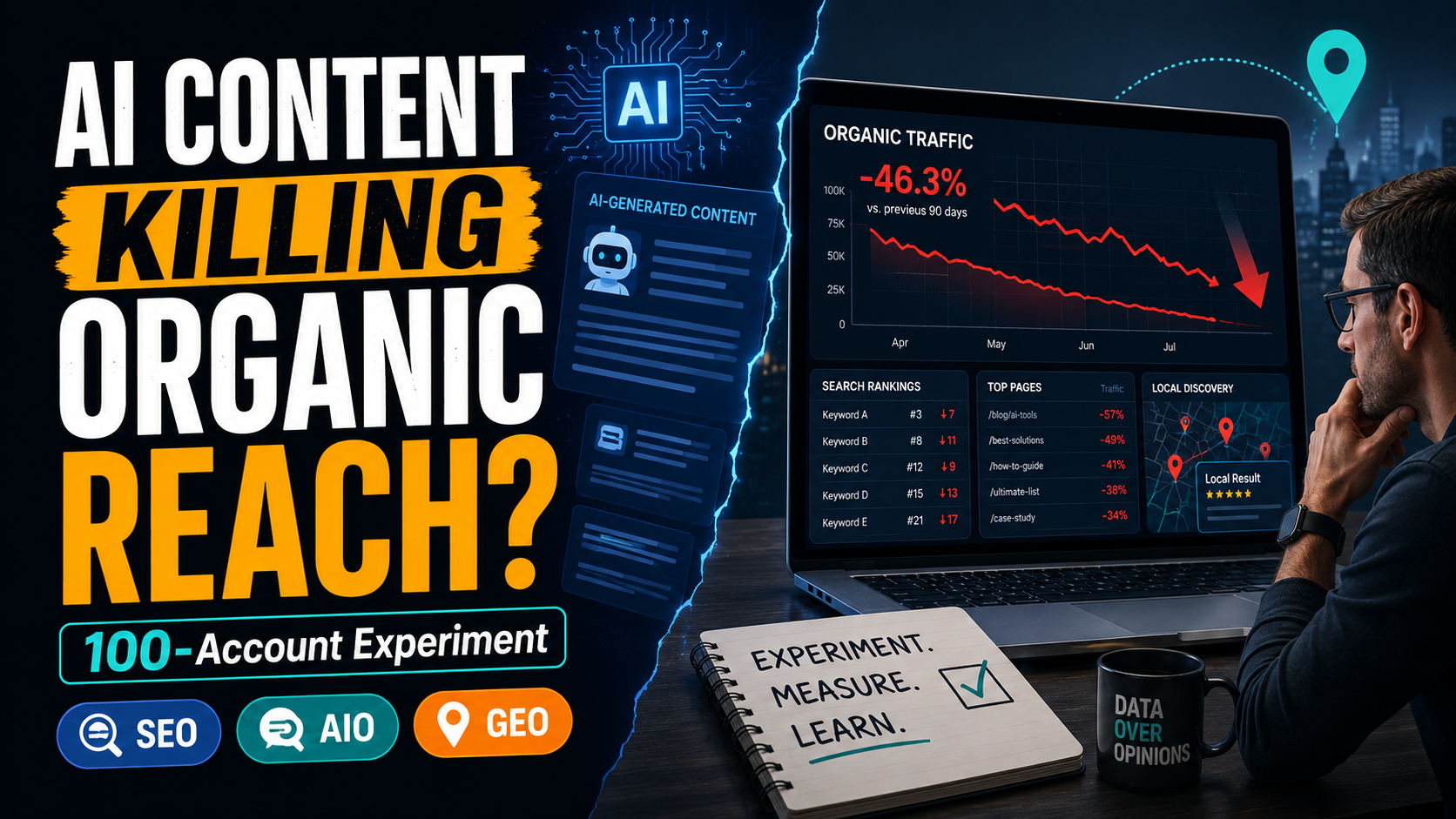
AI content is
everywhere now.
Captions. Reels scripts. Carousel text. LinkedIn posts. YouTube Shorts ideas. Telegram updates. Blog outlines. Ad copies. Even comments sometimes.
At first, it
feels amazing.
You type one
prompt, and within seconds you get content that looks clean, polished, and
ready.
But after some
time, many creators start noticing something strange.
The content
looks good, but reach is low. People see it, but they do not respond. The post
sounds correct, but nobody feels anything. The caption is neat, but comments
are silent.
That is when
the real question comes.
Is AI content
killing your organic reach?
My honest
answer is this: AI content itself is not the enemy. Lazy AI content is the
problem.
Generic AI
content is the problem. Content with no personal story, no local angle, no real
opinion, no proof, no emotion, and no human editing can quietly damage your
reach because people scroll past it.
Platforms do
not need to hate AI for this to happen. People simply ignore content that feels
empty. That is enough.
Quick
Answer: Is AI Content Killing Organic Reach?
AI content can
hurt organic reach when it sounds generic, copied, overly polished, emotionally
flat, or disconnected from the creator’s real experience.
AI-assisted
content can still perform well when a human adds original thoughts, real
examples, personal experience, audience knowledge, strong hooks, and useful
insights.
The problem is
not AI. The problem is publishing AI output without thinking.
In a
100-account experiment framework, the accounts that would likely perform best
are not the ones using zero AI or full AI. The strongest group is usually the
hybrid group: AI for speed, human for soul.
That means AI
can help you draft. But you must add the real voice. Your story. Your proof.
Your opinion. Your audience understanding. That is where reach starts coming
back.
What
We Mean by “100-Account Experiment”
Let me explain
this clearly.
This is not a
fake scientific study. This is a practical experiment framework that any
creator, agency, SMM team, or social media manager can run across 100 accounts
or 100 content samples.
The goal is
simple: compare how different types of content feel and perform.
|
Group |
Content Style |
Main Question |
|
Group A |
Fully
AI-written captions/posts |
Does generic AI
content get ignored? |
|
Group B |
AI draft plus human editing |
Does human editing improve engagement? |
|
Group C |
Fully
human-written posts |
Does natural
voice perform better? |
|
Group D |
Human idea plus AI formatting |
Does AI help when the idea is already strong? |
Track them for
30 days.
Do not look
only at views. Views can lie.
Track saves,
comments, shares, replies, profile visits, link clicks, watch time, and direct
messages. That tells the real story.
Why
AI Content Feels Weak Sometimes
AI content
often looks clean. Too clean sometimes.
That is the
issue.
Real people do
not always write in perfect lines. They repeat things. They pause. They say
small emotional things. They use examples from life. They write from
frustration. They write from experience.
AI often gives
safe, balanced, polished content. Good for structure. Bad for feeling.
A post may be
grammatically correct and still feel dead.
That is why
many AI captions do not perform. They do not sound like a person who has
actually lived the problem. They sound like a summary.
Social media
does not reward summaries as much as it rewards connection.
The
Real Reach Killer: Same-Sounding Content
The biggest
problem with AI content is sameness.
Same hooks.
Same structure. Same words.
Same “in
today’s digital world.” Same “here are 5 tips.” Same “unlock your potential.”
Same “take your brand to the next level.”
People have
seen this too many times. They can feel it. Even if they cannot explain it,
they know something is missing.
That missing
thing is human texture.
A small
mistake. A real example. A sharp opinion. A local phrase. A personal struggle.
A real result. A face. A voice. A normal sentence that does not sound like a
brochure.
That is what
makes content feel alive.
What
Platforms Actually Care About
Most platforms
care about user response.
Do people stop?
Do they watch? Do they comment? Do they save? Do they share? Do they click? Do
they follow? Do they come back?
AI content
becomes a problem when it fails these signals.
So the smart
lesson is this: do not ask only, “Was this written by AI?” Ask, “Will a real
person care?”
That is the
better question.
100-Account
Experiment Setup
Test
Duration
Run the test
for 30 days. That is enough to see early patterns. Not perfect, but useful.
Account
Types
Use different
account types: creators, students, small businesses, local shops, coaches,
gyms, salons, agencies, Telegram communities, YouTube creators, Instagram
pages, and LinkedIn profiles.
This matters
because AI content may behave differently across niches.
Content
Types
Test different
formats: Instagram captions, Reels scripts, YouTube Shorts hooks, LinkedIn
posts, Telegram updates, Facebook posts, carousel text, and short blog
snippets.
Do not test
only one format. Organic reach depends on format too.
Metrics
to Track
|
Metric |
Why It Matters |
|
Reach |
Shows how many
people saw it |
|
Watch time |
Shows whether people stayed |
|
Saves |
Shows
usefulness |
|
Shares |
Shows value or emotion |
|
Comments |
Shows reaction |
|
Profile visits |
Shows curiosity |
|
Link clicks |
Shows action |
|
DMs |
Shows real interest |
|
Follower growth |
Shows trust |
|
Order/support interest |
Shows commercial movement |
Do not track
only likes. Likes are easy. Interest is harder.
The 4
Content Groups
Group
A: Full AI Content
This group uses
AI output almost directly.
No real
editing. No personal examples. No voice correction. No audience detail.
This content
may look clean, but it often feels flat.
Group
B: AI Draft Plus Human Editing
This group uses
AI for the first draft.
Then a human
adds real examples, personal lines, stronger hooks, better CTA, local context,
brand voice, proof, and emotion.
This is usually
the strongest practical method.
Group
C: Fully Human Content
This group uses
no AI.
It may be
slower. It may have small imperfections. But it can feel more real.
This group
often wins in emotional topics, founder-led content, personal brand posts, and
local trust content.
Group
D: Human Idea Plus AI Formatting
This group
starts with a real human idea.
Then AI helps
organize it.
The idea is
human. The structure is AI-assisted.
This can work
very well for blogs, carousels, guides, and educational content.
Expected
Findings From a Real Test
·
Full AI content may publish
faster but usually feels more generic.
·
AI plus human editing may
perform best for consistency and clarity.
·
Fully human content may get
stronger comments and trust when the writer has real experience.
·
Human idea plus AI formatting
may work well for SEO, blogs, LinkedIn, and educational posts.
·
AI is strongest when it helps
organize.
·
Humans are strongest when they
add meaning.
That is the
real lesson.
AI
Content Risk Table
|
Content Type |
Reach Risk |
Why It Happens |
|
Raw AI captions |
High |
Feels generic
and forgettable |
|
AI scripts with no story |
High |
No emotional reason to watch |
|
AI carousels
with common tips |
Medium-High |
Looks useful
but not unique |
|
AI blogs with no experience |
Medium-High |
Weak E-E-A-T |
|
AI plus human
examples |
Low-Medium |
Feels clearer
and more real |
|
Human idea plus AI structure |
Low |
Keeps originality and improves readability |
|
Founder-led
human content |
Low |
Builds trust
faster |
The worst
content is not AI content. The worst content is empty content. AI just makes
empty content faster.
Signs
Your AI Content Is Hurting Reach
·
Your posts sound like everyone
else.
·
Your comments are dropping.
·
People view but do not follow.
·
Your saves are low.
·
Your captions feel polished but
cold.
·
Your hooks sound generic.
·
You keep using the same
phrases.
·
Your content has no real
example.
·
Your brand voice is missing.
·
Your audience does not feel
spoken to.
If this is
happening, do not panic. Fix the content. Do not blame only the algorithm.
What
to Add Before Publishing AI Content
·
One real example.
·
One personal opinion.
·
One clear audience.
·
One specific platform.
·
One real problem.
·
One simple CTA.
·
One proof point if you have it.
·
One sentence that sounds like
you.
For
thebigpython.com, I would also add practical safety lines when the topic is
SMM-related: use public links, start small, read service notes, avoid
passwords, track results, and keep posting real content.
That makes the
content useful and trustworthy.
AI
Content vs Human Content vs Hybrid Content
|
Content Type |
Best Use |
Weakness |
|
Full AI |
Drafting fast |
Can feel
generic |
|
Fully human |
Personal stories and trust |
Slower to create |
|
AI plus human
edit |
Daily content |
Needs editing
discipline |
|
Human idea plus AI format |
Blogs and guides |
Still needs fact-checking |
|
AI captions
only |
Quick posts |
Weak brand
voice |
|
Human hooks plus AI body |
Reels and Shorts |
Must keep emotion alive |
The best system
is not “AI or human.” The best system is AI for speed and human for trust.
TheBigPython
7-Step Human Editing Checklist
Step
1: Read It Out Loud
If it sounds
like a brochure, rewrite it.
Step
2: Add One Real Example
A post without
an example feels empty.
Step
3: Remove Generic Lines
Delete lines
like “in today’s digital age” or “take your brand to the next level.”
Step
4: Add Your Audience
Say who it is
for: students, creators, agencies, small businesses, or resellers.
Step
5: Add One Clear CTA
Tell users what
to do next: read the guide, check services, start small, save this, or reply
with a question.
Step
6: Add Trust and Safety
If the topic
involves SMM services, remind users to use public links, avoid passwords, read
notes, and track orders.
Step
7: Make It Sound Like a Person
Not perfect.
Clear. Useful. Real. That is enough.
Platform-Wise
AI Content Fixes
|
Platform |
AI Content Problem |
Human Fix |
|
Instagram Reels |
Script sounds
generic |
Add real
emotion and faster hook |
|
YouTube Shorts |
Opening is flat |
Add curiosity in first 3 seconds |
|
Telegram |
Message feels
robotic |
Make it short
and direct |
|
LinkedIn |
Post feels like advice everyone knows |
Add lived experience |
|
Facebook |
Content feels
too polished |
Add local
language and real situation |
|
Blogs |
Article lacks proof |
Add examples, tables, FAQ, and internal links |
|
SMM panel pages |
Content feels
salesy |
Add safety,
service notes, and order guidance |
Every platform
needs a different human layer. Do not post the same AI output everywhere.
Why
AI Content Fails for SMM Panel Brands
SMM panel
content already has trust issues in the market.
Many users
worry about safety, passwords, drops, payment delays, fake promises, and
low-quality services.
So if an SMM
panel publishes generic AI content, users may trust it even less.
That is why
thebigpython.com should not publish cold content.
Every guide
should feel useful. Explain how orders work. Explain public-link ordering.
Explain refill and drop rules. Explain payment flow. Explain order status.
Explain what users should not do. Explain when to contact support.
That is how
thebigpython.com can stand apart. Not by shouting “best panel,” but by guiding
people clearly.
Where
TheBigPython Fits
TheBigPython
can use AI carefully, but the content must still feel human.
A user coming
to thebigpython.com may ask: Is this safe? Do I need to share my password?
Which service should I order? How do I add funds? What if my order is pending?
Should I use SMM support or organic content? Can AI help my content?
These are real
questions. The blog should answer them clearly.
·
Public-link ordering
·
Indian payment guidance
·
Order tracking
·
Support tickets
·
Affordable SMM services
·
API guidance
·
Helpful blogs
·
Refill and drop clarity
·
Beginner-friendly instructions
But the message
should stay honest.
AI can help
content. SMM services can support visibility. But real trust still comes from
useful content, clear guidance, and consistent work.
East or West, thebigpython.com is the best, but only when users feel guided first.
Step-by-Step:
How to Use AI Without Killing Reach
Step
1: Start With Your Own Idea
Do not start
with a blank AI prompt. Start with what you actually want to say.
Step
2: Use AI for Structure
Let AI organize
the idea, not replace the idea.
Step
3: Add Human Proof
Add real
examples, results, mistakes, or observations.
Step
4: Rewrite the Hook Yourself
The hook should
sound alive, not generic.
Step
5: Remove Empty Lines
Delete lines
that could apply to any brand.
Step
6: Add Platform Context
Instagram,
YouTube, Telegram, LinkedIn, and blogs need different tones.
Step
7: Track the Result
Check reach,
saves, comments, shares, watch time, clicks, and profile visits. Then improve.
FAQ
Is AI
content killing organic reach?
AI content can
hurt reach when it is generic, emotionless, repetitive, or published without
human editing. AI-assisted content can still perform well when it includes real
examples, strong hooks, and original insight.
Does
Instagram reduce AI content reach?
Instagram’s
creator guidance focuses on originality and recommendation eligibility. Content
that feels copied, low-effort, or unoriginal is more likely to struggle than
content with a strong human layer.
Can
YouTube Shorts use AI scripts?
Yes, but the
hook, pacing, story, and retention still matter. Realistic altered or synthetic
content may also need disclosure under YouTube rules.
Does
Google rank AI-written blogs?
Google says it
focuses on helpful, reliable, people-first content rather than whether content
is AI-generated or human-generated.
What
is the best way to use AI for content?
Use AI for
structure, ideas, and speed. Add human experience, examples, brand voice,
proof, and platform-specific context before publishing.
Why
does AI content feel boring?
Many AI drafts
use common phrases, balanced wording, and generic advice. Without editing, the
content feels correct but not memorable.
Can
SMM support help AI content perform better?
SMM support can
help visibility, but it cannot fix weak content. Improve the hook, idea,
caption, and value first.
How
does thebigpython.com fit into this?
thebigpython.com
can help creators and businesses with social media growth support, public-link
ordering, payment guidance, order tracking, and helpful content guides.
Conclusion
AI content is
not killing organic reach by itself.
Lazy content
is.
Generic content
is.
Content with no
story, no proof, no emotion, no opinion, and no human editing is the real
problem.
AI can help you
move faster. But speed is not enough.
You still need
judgment. You still need audience understanding. You still need a real voice.
You still need trust.
Use AI like an
assistant. Not like your full personality.
Write the idea
yourself. Let AI help with structure. Then add the human layer.
If you use
thebigpython.com for growth support, use the same mindset.
Read the notes.
Use public links. Start small. Track results. Keep creating real content.
By God’s grace,
with honest content, smart editing, and responsible growth support, organic
reach can become stronger again.