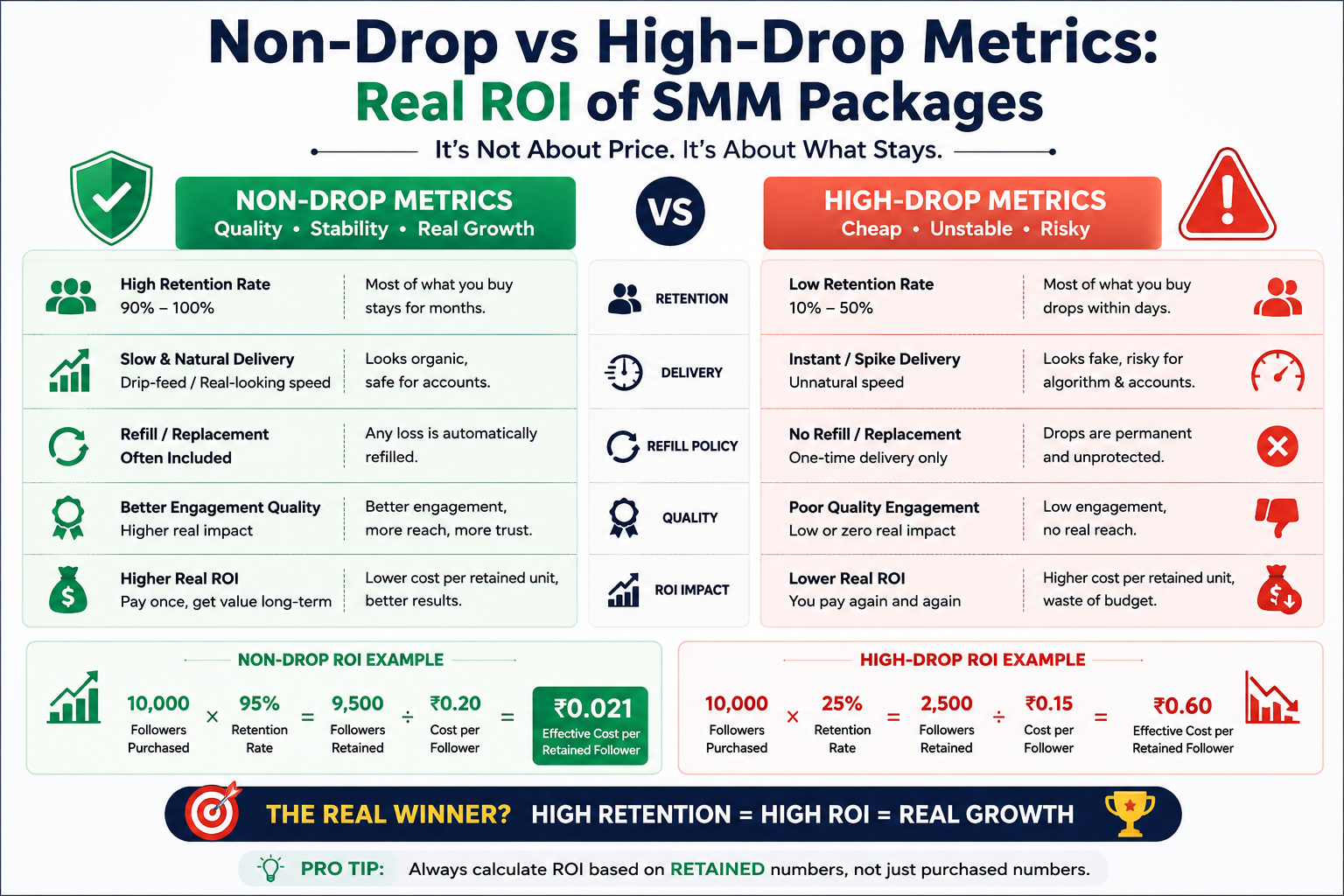
Non-Drop vs. High-Drop Metrics: Calculating the Real ROI of Budget SMM Packages
A low headline price is not always a low final cost. Compare SMM packages by retained results, replacement requirements, effective cost and campaign value.
Budget SMM packages are often compared by a simple question: How much does the package cost? A better question is: How much does each retained unit of delivery actually cost?
This distinction becomes important when comparing services described as non-drop with services that experience a higher level of natural or service-related drop. A cheaper package can look attractive at checkout but become less economical if a large portion of the delivered quantity disappears and has to be replaced.
1. What Is the Difference Between Non-Drop and High-Drop Metrics?
In SMM terminology, a drop is a reduction in a previously delivered metric, such as followers, likes or views. A provider may advertise a non-drop or refill-supported service to indicate stronger retention or replacement coverage.
A high-drop service may have a lower upfront price, but the agency or buyer needs to account for the quantity that is no longer retained. That makes retention an economic variable, not just a quality variable.
| Metric | Non-Drop-Oriented Service | High-Drop Service |
|---|---|---|
| Headline price | May be higher | Often lower |
| Retained quantity | Potentially higher, depending on provider | Potentially lower |
| Replacement needs | May be lower if refill terms apply | Can be higher |
| Management effort | Usually easier to budget | May require more monitoring |
| True cost comparison | Should use retained units | Should include replacement costs |
2. The Most Useful Metric: Retention Rate
Suppose a package delivers 10,000 units and 9,000 remain after the measurement period. The retained quantity is 9,000 and the retention rate is 90%.
This simple number allows agencies to compare packages that have different prices and different drop behavior.
3. Calculate the Effective Cost Per Retained Unit
The next step is to move beyond the advertised price. If a package costs ₹1,000 and ultimately retains 8,000 of 10,000 delivered units, the effective cost per retained unit is:
Now compare that with a ₹1,300 package that delivers 10,000 units and retains 9,500:
In this example, the cheaper service still has the lower effective cost per retained unit. That is precisely why agencies should calculate rather than assume. A higher-retention service is not automatically the better financial choice, and a low-price service is not automatically the worse one.
4. Add Refill and Replacement Costs
Retention becomes more complicated when a buyer repeatedly purchases replacement units. If a service drops and the buyer places additional orders, the total campaign cost increases.
For agencies, management time also has economic value. Someone has to identify drops, contact support, submit refill requests, update spreadsheets and explain delays to clients. A service that requires repeated intervention can therefore cost more than its original invoice suggests.
5. A Simple ROI Formula for SMM Packages
ROI is meaningful only when the agency defines what “return” means. For a reseller, it may be gross contribution after fulfillment costs. For a brand, it may be revenue, leads, conversions or another business outcome.
For example, if a client pays ₹5,000 for a campaign package and the agency's total fulfillment and management cost is ₹3,000, the contribution before other business expenses is ₹2,000.
This does not mean the social campaign generated ₹5,000 in sales. It is an example of service-level economics. A true marketing ROI calculation should use the business outcome attributable to the campaign.
6. Compare Packages Using a Retention-Adjusted Scorecard
| Factor | Weight Example | Why It Matters |
|---|---|---|
| Effective cost per retained unit | 25% | Shows actual cost after retention losses. |
| Retention / drop history | 20% | Indicates how much delivery remains over time. |
| Refill terms | 15% | Can reduce replacement expenses when applicable. |
| Support quality | 15% | Reduces time lost on operational issues. |
| Delivery consistency | 15% | Helps agencies plan client campaigns. |
| Reporting / API workflow | 10% | Can improve scalability and automation. |
The percentages are illustrative. Each agency can change the weights according to its client model.
7. Why a Higher-Price Package Can Sometimes Be Cheaper
Consider two hypothetical packages:
| Package A | Package B | |
|---|---|---|
| Price | ₹800 | ₹1,100 |
| Delivered | 10,000 | 10,000 |
| Retained after test period | 7,000 | 9,200 |
| Initial cost / retained unit | ₹0.114 | ₹0.120 |
Package A still wins on initial retained-unit cost in this specific example. But suppose A requires ₹500 of replacement orders and two hours of staff intervention while B requires no replacement during the same period. The gap can disappear quickly.
The lesson is simple: retention, replacement and labor should be included in the comparison.
8. Non-Drop Claims Need Careful Verification
A provider may describe a service as non-drop, lifetime refill or high retention. Those labels should be examined through the actual terms. Agencies should ask:
- How long does refill coverage last?
- What counts as a qualifying drop?
- What events are excluded?
- Is the refill automatic or manual?
- Are deleted posts or changed usernames excluded?
- What happens if the underlying platform changes its systems?
There is no practical basis for interpreting “non-drop” as “nothing can ever decrease.” Social platforms can remove accounts, content or activity, and audiences can naturally change over time.
9. High-Drop Does Not Always Mean Worthless
A high-drop service may still have a place in a short-duration campaign if its price is low enough and the buyer understands its characteristics. The decision depends on the campaign objective and measurement period.
For example, a temporary awareness experiment may be evaluated differently from a long-term client-retention package. What matters is whether the service's actual economics and risk profile fit the objective.
10. Measure More Than Followers, Likes or Views
Public metrics are only one layer of performance. For genuine marketing ROI, agencies should also track:
- Profile visits
- Website clicks
- Leads
- Conversions
- Cost per acquisition
- Engagement quality
- Audience relevance
- Revenue attributable to the campaign
A package that increases a visible counter but contributes nothing to qualified traffic may have weak business ROI. Conversely, a smaller increase in a relevant audience can be more valuable.
11. How Agencies Can Build a Better Budget SMM Procurement Process
- Define the objective: decide whether the purchase is operational support, awareness, testing or another purpose.
- Set the measurement window: decide when retention will be evaluated.
- Run a small test: avoid moving large client budgets immediately.
- Record delivered quantity: capture the starting number.
- Record retained quantity: measure the same metric later.
- Track replacement spend: include refill and re-order costs.
- Track staff time: estimate the operational cost of managing problems.
- Compare effective cost: calculate cost per retained unit.
- Measure business outcomes: connect the campaign to qualified traffic, leads or revenue where possible.
12. Where TheBigPython Fits Into the Comparison
Agencies researching budget SMM fulfillment can include TheBigPython in their provider comparison. Current pricing, service descriptions, refill policies and availability should always be checked directly before placing significant orders.
Useful related resources and service information are available at TheBigPython.com.
Common Mistakes When Comparing SMM Packages
- Comparing only the initial price.
- Treating “non-drop” as a literal permanent guarantee.
- Ignoring the time cost of replacements and support tickets.
- Measuring only public counters instead of meaningful business outcomes.
- Scaling before completing a controlled test.
- Promising clients a guaranteed result that the provider does not guarantee.
- Ignoring platform rules or account-level risks.
Frequently Asked Questions
What does non-drop mean in SMM services?
It generally refers to a service marketed around stronger retention or refill support. The exact meaning depends on the provider's terms and should not be interpreted as a permanent guarantee.
How do I calculate the real cost of an SMM package?
Start with the package price, then account for replacement purchases and relevant management costs. Divide the total cost by the quantity actually retained to estimate effective retained-unit cost.
Is a non-drop package always better than a high-drop package?
No. A higher-retention package may cost more. The better option depends on retained-unit economics, replacement costs, campaign duration and the intended objective.
What is the most important metric for comparing budget packages?
Effective cost per retained unit is a useful starting point, but support, delivery consistency, terms and actual marketing outcomes should also be considered.
Can SMM package metrics prove marketing ROI?
No. Retention and delivery metrics measure service economics. Marketing ROI requires connecting campaign activity to relevant outcomes such as qualified traffic, leads, conversions or revenue.
Final Takeaway
The cheapest SMM package is not necessarily the most economical. Non-drop vs. high-drop comparisons become much clearer when you calculate retention rate, effective cost per retained unit, replacement spend and management effort.
Use the headline price as the starting point—not the final answer. Test small, document retention, verify provider terms and connect social metrics to real business outcomes.
Explore SMM resources: TheBigPython.com