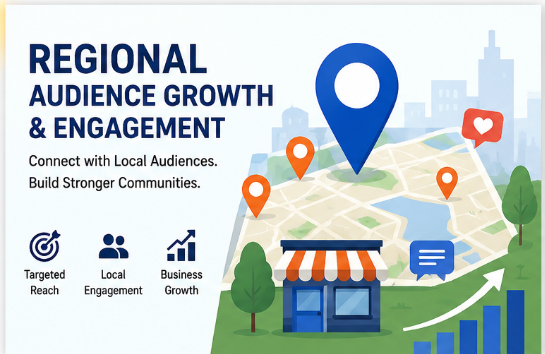
Regional Audience Growth and Engagement Services: Building Stronger Local Connections
The internet has removed geographical boundaries from marketing. A business in one city can reach customers across the country or even around the world.
But broader reach is not always better.
For many businesses, the most valuable audience is the one closest to their market. A restaurant wants nearby customers. A local gym needs people who can visit its facility. A real estate company needs buyers looking for properties in particular locations.
This is where regional audience growth and engagement services can make a difference.
Regional marketing focuses on building visibility and interaction among people in specific locations. By combining social media, localized content, audience targeting, influencer marketing, and digital advertising, businesses can develop a stronger presence within the markets they serve.
What Are Regional Audience Growth Services?
Regional audience growth services are digital marketing solutions designed to help brands attract and engage audiences from specific geographical areas.
A regional campaign may target:
- Cities
- Districts
- States
- Countries
- Language-based markets
- Specific local communities
Depending on the business, the strategy can include social media growth, content promotion, local SEO, paid advertising, influencer marketing, and community management.
The goal is to attract an audience that is not only interested in the content but is also relevant to the business's target market.
Why Businesses Need Regional Audience Growth
Having a large social media audience can look impressive, but audience relevance is extremely important.
Imagine a local restaurant with 100,000 followers. If only a small percentage of those followers live near the restaurant, the account may not generate as many customers as expected.
Now imagine another restaurant with 15,000 followers, most of whom live in the same city.
The second account may have significantly more commercial value because its audience is closer to the business.
This is why businesses should consider audience quality and relevance alongside audience size.
Local Engagement Creates Stronger Connections
People naturally pay attention to content that feels relevant to their daily lives.
A local business can use regional content to talk about:
- Local events
- Popular places
- Regional festivals
- Community activities
- Local trends
- Nearby services
- Regional culture
This can encourage users to interact because the content is familiar to them.
Instead of simply advertising a product, a brand becomes part of the local conversation.
Key Benefits of Regional Engagement
Targeted Visibility
Regional campaigns help businesses focus their marketing efforts on selected markets.
This can reduce wasted exposure and make campaigns more relevant.
Better Brand Recognition
Consistent exposure within a specific region can help people become familiar with a brand.
Over time, familiarity can contribute to stronger brand recall.
Local Customer Relationships
Businesses can interact directly with customers in their service areas.
This creates opportunities to answer questions, collect feedback, and build community relationships.
Improved Marketing Relevance
A regional campaign can be customized according to local preferences, language, culture, and trends.
Stronger Conversion Opportunities
When the audience is geographically relevant, engagement has a greater possibility of turning into inquiries, visits, bookings, or purchases.
Regional Social Media Strategy
A successful regional social media strategy starts with identifying the ideal market.
For example, a business may decide to target:
Primary market: Bhopal
Secondary markets: Sehore and nearby areas
The content and advertising strategy can then be designed around these locations.
Businesses can use:
- Location tags
- Local hashtags
- Regional keywords
- City-specific content
- Local creators
- Community pages
- Targeted advertising
The strategy should remain consistent with the brand's overall identity.
Importance of Localized Language
Language can have a major influence on audience engagement.
A brand targeting a particular region can experiment with the language that its customers naturally use.
This doesn't necessarily mean translating every piece of content.
It can also involve using:
- Local expressions
- Regional terminology
- Familiar phrases
- Cultural references
- Appropriate humor
The result can be communication that feels more natural to the target audience.
Local Influencers and Creators
Regional creators can help businesses reach highly relevant audiences.
A creator may have fewer followers than a national influencer but still have a strong influence within a specific city.
For example, a local food creator could help a restaurant reach people who actually live nearby.
Regional creators can promote:
- Restaurants
- Gyms
- Clothing stores
- Events
- Hotels
- Travel destinations
- Local products
- New business launches
The most important factor is not simply follower count. Businesses should evaluate audience relevance, engagement quality, content style, and location.
Regional Campaigns for Different Industries
Almost any industry can benefit from localized engagement.
Restaurants
Restaurants can promote menus, offers, events, and new dishes to nearby audiences.
Fitness Businesses
Gyms and fitness studios can target people within practical travel distance of their facilities.
Real Estate
Property businesses can focus on buyers and investors interested in particular locations.
Education
Coaching centers and schools can target students and parents within their service areas.
Retail
Local stores can use social media to promote products, offers, and store events.
Tourism
Hotels, travel companies, and attractions can promote regional destinations to relevant travelers.
Localized Content Ideas
Businesses looking for regional content ideas can create:
Local Guides:
Share useful information about places, activities, or services in the region.
Customer Stories:
Feature customers from the local community.
Behind the Scenes:
Show how the business operates locally.
Local Events:
Create content around relevant events and celebrations.
Regional Trends:
Participate in local conversations and trends.
Special Offers:
Create promotions specifically for customers in the target area.
This type of content can make a social media profile more connected to its community.
Combining Organic and Paid Strategies
Regional growth can involve both organic and paid marketing.
Organic strategies include:
- Local content
- Community engagement
- Hashtags
- Collaborations
- User-generated content
- Local SEO
Paid strategies can include:
- Location-based advertising
- Sponsored posts
- Regional influencer campaigns
- Retargeting
- Promotional campaigns
Using both approaches can provide immediate visibility while also supporting long-term audience development.
Regional SEO
Search engines are another important component of local digital marketing.
Businesses should consider optimizing their online presence for location-specific searches.
For example:
Instead of targeting only:
“Best gym”
A business might also target:
“Best gym in Bhopal”
Other useful local SEO elements include:
- Google Business Profile
- Location pages
- Local keywords
- Customer reviews
- Local directories
- Location-based website content
Social media and local SEO can complement each other by creating multiple ways for customers to discover a business.
How to Measure Regional Engagement
Successful marketing requires measurement.
Businesses can monitor:
- Regional reach
- Engagement rate
- Comments
- Shares
- Profile visits
- Website clicks
- Leads
- Calls
- Messages
- Bookings
- Sales
If a campaign produces high engagement but no business inquiries, the strategy may need to be adjusted.
Likewise, a campaign with a smaller reach but strong conversions may be highly valuable.
The focus should therefore be on business outcomes rather than vanity metrics alone.
Choosing a Regional Engagement Provider
Before working with a marketing provider, businesses should ask several questions.
Is the Audience Relevant?
The provider should have a strategy for reaching the desired regions.
Are the Methods Transparent?
Businesses should understand what type of marketing activity is being performed.
Is Reporting Available?
Regular reporting makes it easier to evaluate performance.
Is the Strategy Customized?
Different industries and locations require different approaches.
Are Results Measurable?
The campaign should ideally connect engagement with meaningful metrics such as leads, traffic, inquiries, or sales.
The Role of Data in Regional Marketing
Modern marketing allows businesses to analyze audience behavior and improve campaigns over time.
Data can reveal:
- Which locations respond best
- Which content generates engagement
- Which age groups interact most
- Which offers perform well
- Which channels generate leads
Businesses can use these insights to refine their targeting and allocate resources more effectively.
Common Regional Marketing Mistakes
Chasing Numbers Instead of Relevance
A large audience is not automatically a valuable audience.
Ignoring Local Preferences
Different regions can have different expectations and communication styles.
Posting Generic Content
Local audiences may respond better to content that reflects their environment.
Not Tracking Conversions
Engagement should ultimately support measurable business objectives.
Inconsistent Posting
Building regional awareness requires consistency.
The Future of Regional Audience Engagement
Digital marketing is moving toward increasingly personalized experiences.
Location, language, interests, behavior, and other signals can help businesses deliver more relevant content to different audiences.
Artificial intelligence and marketing automation are also making it easier to personalize campaigns at scale.
As competition increases across digital platforms, businesses that understand their specific communities can gain an important advantage.
Conclusion
Regional audience growth and engagement services provide businesses with a focused approach to digital marketing.
Instead of trying to reach everyone, brands can concentrate on audiences that are geographically relevant and more likely to become customers.
Through localized content, regional social media strategies, local influencers, targeted advertising, and local SEO, businesses can build stronger visibility and deeper connections.
Ultimately, successful regional marketing is not about collecting the biggest possible number of followers.
It is about building an engaged, relevant, and valuable audience within the markets that matter most to your business.