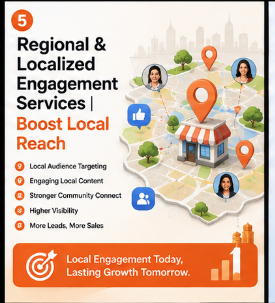
Regional and Localized Engagement Services: A Complete Guide to Growing Local Audiences
In today’s digital-first world, reaching a large audience is no longer enough. Businesses, creators, agencies, and local brands need to reach the right audience in the right location.
This is where regional and localized engagement services become valuable. Instead of focusing only on global or broad audiences, localized engagement strategies help businesses connect with people based on their city, state, region, language, culture, and interests.
Whether you operate a local business, manage social media accounts, run an e-commerce brand, or promote content for a specific geographical market, regional engagement can help create stronger connections with potential customers.
What Are Regional and Localized Engagement Services?
Regional and localized engagement services are digital marketing and social media services designed to help brands connect with audiences in specific geographic areas.
For example, a restaurant in Bhopal may want to reach people specifically in Bhopal rather than users across India. Similarly, a clothing business in Madhya Pradesh may want to build visibility among customers in nearby cities.
Localized engagement can include:
- Local social media engagement
- Regional audience targeting
- Location-based content promotion
- Local hashtag strategies
- Regional influencer marketing
- Local-language content
- City-specific campaigns
- Community engagement
- Local business promotion
- Regional social media growth strategies
The main objective is to make digital marketing feel more relevant, personal, and connected to a particular audience.
Why Regional Engagement Matters
People naturally connect more strongly with content that reflects their location, language, culture, and lifestyle.
A local customer may be more interested in a business that understands their community than a generic brand that targets everyone.
For example, consider two advertisements:
Advertisement A:
“Best food available. Order now.”
Advertisement B:
“Looking for the best street-style food in your city? Visit us today!”
The second message immediately creates a stronger local connection.
Localized marketing works because it makes the audience feel that the content was created specifically for them.
Benefits of Localized Engagement Services
1. Reach the Right Audience
One of the biggest advantages of regional engagement is audience relevance.
Instead of trying to reach millions of random users, businesses can focus on people who are more likely to be interested in their products or services.
This can improve the overall efficiency of social media marketing campaigns.
2. Build Local Brand Awareness
For small and medium-sized businesses, local brand awareness is extremely important.
A business may not need worldwide recognition. It may simply need to become well-known within its city or region.
Regional engagement can help businesses repeatedly appear in front of local audiences and gradually build recognition.
3. Improve Community Engagement
Local audiences often respond better to content that relates to their community.
Posts about local events, festivals, landmarks, food, traditions, and regional trends can encourage people to comment, share, and interact.
This can help transform a social media account from a simple promotional page into a local community platform.
4. Strengthen Customer Trust
Trust is an important factor in online purchasing decisions.
When a business consistently publishes relevant local content and interacts with its regional audience, it can appear more authentic and accessible.
Customers may feel more comfortable engaging with a business that understands their local market.
5. Support Local Businesses
Restaurants, gyms, salons, coaching centers, retailers, real estate companies, travel businesses, and service providers can benefit significantly from regional marketing.
For these businesses, customers are often located within a specific geographic area.
Localized engagement allows them to focus their marketing efforts where potential customers actually live.
Regional Social Media Marketing
Social media platforms provide businesses with powerful opportunities to connect with specific communities.
A regional social media strategy can include:
- Location-based posts
- City-specific hashtags
- Regional reels
- Local collaborations
- Community polls
- Local event coverage
- Regional influencer partnerships
- User-generated content
- Local offers and promotions
For example, a business targeting customers in Indore could create content around local food trends, city events, popular locations, and regional interests.
The goal is not simply to mention the city name. The content should genuinely feel relevant to people from that area.
The Importance of Localized Content
Content localization goes beyond translating a post.
It involves adapting content to match the audience's:
- Language
- Culture
- Preferences
- Lifestyle
- Humor
- Buying behavior
- Local events
- Regional trends
For example, a campaign targeting Hindi-speaking audiences may perform differently from an English-only campaign.
Similarly, content designed for audiences in Mumbai may need a different communication style from content targeting audiences in a smaller city.
Understanding these differences can make marketing communication more effective.
Regional Hashtag Strategies
Hashtags can help categorize and discover social media content.
A localized hashtag strategy can combine broad, niche, and location-based hashtags.
For example:
Broad:
#DigitalMarketing
Niche:
#LocalBusinessMarketing
Location-based:
#BhopalBusiness
#IndoreBusiness
#MadhyaPradesh
However, businesses should avoid adding irrelevant hashtags simply because they are popular.
The best approach is to use hashtags that genuinely relate to the content, business, and target audience.
Local Influencer Marketing
Influencer marketing can become even more effective when it is localized.
A regional influencer may have a smaller audience than a national celebrity, but their audience can be highly relevant to a specific city or region.
For example, a local food creator can be an excellent promotional partner for a restaurant because their followers may already live nearby.
This creates a more focused form of influencer marketing.
Localized Engagement for E-Commerce Businesses
E-commerce businesses can also use regional engagement strategies.
Although online stores can sell products across the country, localized campaigns can help them understand and target specific markets.
Businesses can create campaigns based on:
- City
- State
- Language
- Regional festivals
- Local buying preferences
- Seasonal demand
- Shipping availability
For example, a fashion brand could create separate campaigns for different regions based on local fashion trends and seasonal preferences.
Regional Engagement for Service Businesses
Service-based businesses can particularly benefit from localized marketing.
Examples include:
- Gyms
- Salons
- Restaurants
- Clinics
- Coaching centers
- Real estate agencies
- Photographers
- Travel agencies
- Event planners
- Digital marketing agencies
- Repair services
A customer looking for a nearby service is generally more valuable than an irrelevant follower from another part of the world.
Therefore, localized engagement can help businesses focus their social media strategy on commercially relevant audiences.
How Regional Engagement Services Work
A successful localized engagement campaign generally follows several steps.
Step 1: Identify the Target Region
First, determine exactly where the target audience is located.
This could be:
- A city
- Multiple cities
- A district
- A state
- A country
- A language-based region
Step 2: Understand the Audience
Next, businesses should research the target audience.
Important factors include:
- Age group
- Interests
- Language
- Online behavior
- Purchasing habits
- Local trends
- Content preferences
Step 3: Develop Localized Content
Content should then be adapted to the selected audience.
This may include regional language, local references, location-based visuals, and community-focused topics.
Step 4: Promote and Engage
Businesses can distribute their content through organic social media strategies, advertising, influencer collaborations, and community engagement.
Step 5: Measure Results
Finally, businesses should monitor performance.
Important metrics can include:
- Reach
- Engagement rate
- Comments
- Shares
- Profile visits
- Website traffic
- Leads
- Sales
- Local inquiries
These insights can be used to improve future campaigns.
Organic vs Paid Localized Engagement
Localized engagement can be achieved through both organic and paid strategies.
Organic Engagement
Organic strategies include:
- Regular local content
- Community interaction
- Local hashtags
- Comment engagement
- User-generated content
- Local collaborations
- Regional SEO
These methods can take time but may help establish long-term community connections.
Paid Engagement
Paid strategies can include:
- Location-targeted social media advertising
- Regional promotional campaigns
- Sponsored content
- Local influencer campaigns
- Retargeting campaigns
Paid marketing can help businesses reach specific geographic audiences more quickly.
A combination of organic and paid strategies is often useful for sustainable growth.
Regional SEO and Local Discovery
Localized engagement should not be limited to social media.
Search engines are another major source of local customers.
Businesses can improve local discovery by optimizing:
- Google Business Profile
- Website location pages
- Local keywords
- Business directories
- Customer reviews
- Local backlinks
- Location-specific content
For example, instead of targeting only the keyword “digital marketing agency,” a company may also target phrases such as “digital marketing agency in Bhopal.”
This makes the website more relevant to people searching for services in a particular location.
Common Mistakes in Localized Engagement
Localized marketing can fail when businesses focus on location without understanding the audience.
Some common mistakes include:
Targeting the Wrong Audience
Simply selecting a location does not guarantee that users are interested in your product.
Using Irrelevant Hashtags
Popular hashtags may bring impressions but not necessarily valuable engagement.
Ignoring Local Culture
Content should respect regional culture, language, traditions, and communication styles.
Focusing Only on Follower Numbers
A large follower count is not always useful if the audience is irrelevant to the business.
Inconsistent Engagement
Building a local community requires consistent posting and interaction.
How to Choose a Regional Engagement Service
When selecting a service provider, businesses should consider:
Audience targeting:
Can the provider target the regions or cities that matter to your business?
Transparency:
Are the methods and reporting clear?
Quality of engagement:
Does the service focus on relevant users rather than meaningless numbers?
Reporting:
Can you measure reach, engagement, traffic, leads, or conversions?
Strategy:
Does the provider offer a customized approach rather than the same package for every business?
A reliable provider should focus on meaningful audience growth and business objectives rather than only vanity metrics.
Future of Regional and Localized Marketing
The future of digital marketing is becoming increasingly personalized.
As businesses collect better audience insights and platforms improve their targeting capabilities, localized marketing can become more precise.
Artificial intelligence, automation, location-based advertising, local creators, multilingual content, and personalized recommendations are likely to play an increasingly important role.
Businesses that understand their local audiences can create stronger relationships and compete more effectively in crowded markets.
Conclusion
Regional and localized engagement services provide businesses with a way to connect with audiences based on geography, language, culture, and local interests.
Instead of trying to reach everyone, businesses can focus on the people who are most relevant to their products and services.
From local social media campaigns and regional influencers to location-based advertising and local SEO, there are many ways to build a strong regional digital presence.
The key is to focus on relevance, authenticity, consistency, and measurable results.
For local businesses and growing brands, the goal should not simply be to gain more followers. The goal should be to build an audience that can become a genuine community of customers, supporters, and long-term brand advocates.