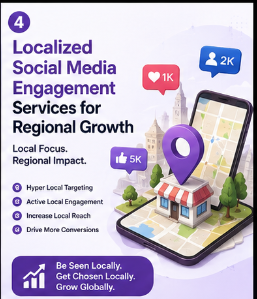
Localized Social Media Engagement Services: Connect With the Audience That Matters
Social media has made it possible for businesses to reach people around the world within seconds. However, reaching a huge audience does not always mean reaching the right audie
nce.
For many businesses, the most valuable customers are located in a particular city, state, region, or language market. A restaurant needs customers nearby. A local gym needs members from its surrounding area. A real estate company needs potential buyers in specific locations.
This is why localized social media engagement services are becoming an important part of modern digital marketing.
Instead of treating every social media user as the same, localized engagement focuses on connecting brands with audiences who are geographically and culturally relevant.
What Is Localized Social Media Engagement?
Localized social media engagement is a marketing approach that focuses on building interaction with audiences in specific geographic markets.
It can involve:
- Regional audience targeting
- City-based social media campaigns
- Local content promotion
- Location-specific hashtags
- Regional influencer collaborations
- Local community engagement
- Multilingual social media content
- Location-based advertising
- Local business promotion
The objective is to generate meaningful visibility and interaction within a defined market.
For example, a café operating in Jaipur would benefit more from strong engagement among people in Jaipur than from thousands of unrelated users living hundreds of kilometers away.
Why Local Audiences Are Valuable
Local audiences often have a stronger connection to businesses operating in their area.
Consider a customer searching for a gym. A fitness page with 50,000 followers may look impressive, but if most followers are located in different cities, those numbers may have limited value to a local gym.
On the other hand, a smaller account with an active audience from the same city could generate more inquiries and memberships.
This demonstrates an important principle:
Relevant engagement can be more valuable than large-scale engagement.
Regional Engagement vs General Engagement
Traditional social media marketing often focuses on increasing overall reach, impressions, followers, likes, and views.
Localized marketing adds another layer: where the audience comes from.
A general campaign might target:
Users interested in fitness.
A localized campaign might target:
Fitness enthusiasts living in a specific city or region.
The second approach allows businesses to align their marketing activity more closely with their actual customer base.
Major Benefits of Regional Engagement Services
1. More Relevant Audience Exposure
Localized campaigns can help businesses appear in front of people who are more likely to become customers.
This is particularly useful for businesses that depend on physical locations.
2. Stronger Local Brand Recognition
Repeated exposure within a specific community can help people recognize a brand.
When users repeatedly see a local business on Instagram, Facebook, Google, or other platforms, the business can gradually become more familiar.
3. Better Community Relationships
Local marketing allows businesses to participate in conversations happening within their community.
Brands can discuss local events, festivals, trends, problems, and celebrations.
This makes the brand feel less like an advertisement and more like a participant in the community.
4. Increased Local Discoverability
A strong regional strategy can improve the chances of being discovered by people searching for local products and services.
Location-based content can work alongside local SEO to improve digital visibility.
5. More Focused Marketing Budgets
Businesses do not always need to advertise everywhere.
If the majority of customers come from a particular area, concentrating marketing resources there can make campaigns more efficient.
Localized Content Strategy
Content is one of the most important components of regional marketing.
A successful localized content strategy should answer a simple question:
“Why would someone from this location care about this content?”
Content can be localized through:
Location
Mention cities, neighborhoods, districts, or regions where relevant.
Language
Use the language or communication style that the target audience understands naturally.
Culture
Consider local traditions, celebrations, customs, and interests.
Events
Create content around relevant local events and activities.
Community
Highlight customers, local creators, businesses, and community stories.
Local Hashtags and Keywords
Hashtags and keywords can help connect social content with regional searches and conversations.
For example, a business targeting audiences in Madhya Pradesh might use relevant combinations such as:
- #MadhyaPradesh
- #Bhopal
- #Indore
- #MPBusiness
- #BhopalBusiness
- #IndoreBusiness
However, businesses should avoid excessive or unrelated hashtags.
The strategy should focus on relevance rather than quantity.
Regional Influencer Campaigns
Local influencers can provide another powerful way to reach regional audiences.
A creator with 10,000 highly relevant local followers may provide more value to a local business than a creator with hundreds of thousands of followers spread across multiple countries.
Businesses can collaborate with regional creators for:
- Product reviews
- Reels
- Local event coverage
- Restaurant promotions
- Store visits
- Product launches
- Giveaways
- Community campaigns
The most important factor is audience relevance.
Localized Engagement for Small Businesses
Small businesses often have limited marketing budgets.
Instead of competing directly with large national brands, they can focus on dominating their local market.
A local salon, for example, could create content featuring:
- Before-and-after transformations
- Local customer stories
- Festival offers
- Nearby location information
- Local beauty trends
- Customer testimonials
Over time, this content can help establish the business as a familiar name within the local community.
Localized Engagement for Startups
Startups entering a new market can also benefit from regional engagement.
Before expanding nationally, a company can test its product or service within selected cities.
This provides opportunities to learn:
- Which content performs best
- Which audience responds most strongly
- Which offers generate interest
- Which locations produce more leads
- Which communication styles work
The information gathered from regional campaigns can then be used to improve larger marketing strategies.
Combining Local SEO With Social Media
Social media and search marketing can work together.
A customer might discover a local business through an Instagram Reel, search for the business on Google, read reviews, and eventually visit the website.
Because of this journey, businesses should maintain consistency across their digital channels.
Important local SEO elements include:
- Google Business Profile
- Accurate business information
- Local website pages
- Customer reviews
- Location keywords
- Business directories
- Local content
A strong social presence combined with local search visibility can create multiple opportunities for customers to discover a business.
Measuring Localized Engagement
Businesses should measure more than likes and followers.
Useful metrics include:
Local Reach
How many users from the target region saw the content?
Engagement
How many relevant users interacted with posts?
Profile Visits
Did regional users visit the business profile?
Website Traffic
Did social media users visit the website?
Leads
How many inquiries came from the campaign?
Conversions
Did engagement result in sales, bookings, registrations, or store visits?
These metrics provide a clearer picture of campaign performance.
Building Long-Term Regional Communities
Successful localized marketing is not just about running advertisements.
It is about building relationships.
Businesses can strengthen their regional communities by:
- Responding to comments
- Reposting customer content
- Highlighting local customers
- Working with local creators
- Supporting community events
- Sharing useful local information
- Creating conversations instead of only promotions
When people feel connected to a brand, they are more likely to interact with it repeatedly.
Mistakes to Avoid
Localized marketing requires careful planning.
Don't Fake Local Engagement
Using irrelevant or artificial engagement may increase numbers temporarily but does not necessarily create customers.
Don't Ignore Audience Quality
A campaign should focus on relevant users rather than simply maximizing impressions.
Don't Copy the Same Content Everywhere
A message that works in one region may not work in another.
Don't Forget Analytics
Without tracking results, it becomes difficult to understand whether regional marketing is actually producing business value.
Choosing the Right Localized Engagement Service
Before selecting a provider, businesses should evaluate several factors.
Targeting: Can the service focus on the required cities or regions?
Strategy: Is the campaign customized for the business?
Transparency: Are methods and results clearly explained?
Reporting: Are useful performance metrics provided?
Quality: Does the service prioritize relevant engagement?
Long-term value: Does the strategy support genuine audience development?
A good localized marketing strategy should be designed around the business's actual customers and objectives.
The Future of Regional Digital Marketing
Digital marketing is becoming increasingly personalized.
Businesses can now create campaigns based on location, language, interests, behavior, and other audience signals.
At the same time, consumers increasingly expect brands to understand their needs and communicate in relevant ways.
This makes regional marketing an important opportunity for businesses that want to build strong local visibility.
From neighborhood businesses to growing national brands, localized engagement can help companies establish stronger relationships with specific communities.
Conclusion
Localized social media engagement services help businesses move beyond generic audience growth and focus on people who are genuinely relevant to their market.
Through regional content, local influencers, location-based campaigns, community interaction, and local SEO, brands can build stronger awareness and relationships within specific markets.
The goal isn't simply to collect more likes or followers.
The goal is to create relevant visibility, meaningful engagement, and real business opportunities within the regions that matter most.