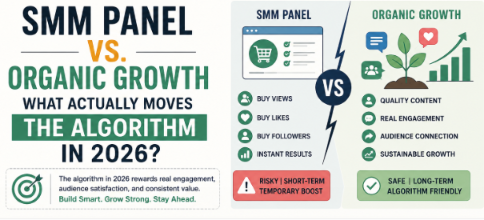
The debate around SMM panels and organic growth often focuses on numbers: followers, likes, views and comments. But modern recommendation systems are designed to evaluate whether people genuinely find content useful or entertaining. That makes the quality of audience response more important than a simple metric total.
Social platforms have become increasingly sophisticated at distinguishing useful engagement from artificial or low-quality activity. As a result, the most important question in 2026 is not simply whether a creator can increase a visible metric. The more useful question is whether the activity produces real audience interest that recommendation systems can recognize.
This distinction matters when comparing an SMM panel with organic growth. An SMM panel is generally a dashboard through which users can order social-media services such as followers, views, likes or other forms of engagement. Organic growth, by contrast, comes from people discovering content naturally and choosing to watch, follow, share or interact with it.
What Does “Move the Algorithm” Actually Mean?
“The algorithm” is often treated as one mysterious score, but recommendation systems are collections of ranking and distribution models. Their exact formulas are proprietary and can change. Creators should therefore avoid claims that a particular purchased metric will directly “activate” or “hack” an algorithm.
A more useful framework is to ask whether a piece of content creates evidence of viewer satisfaction and relevance. Depending on the platform and format, that can include viewing behavior, retention, meaningful interactions, shares, repeat viewing and other signals.
YouTube, for example, says its engagement metrics are designed to reflect legitimate activity from actual humans and that its systems verify engagement events. citeturn0search5
Why Raw Numbers Can Be Misleading
Imagine two videos with 50,000 views. The first attracts people who watch most of the video, share it with friends and later return to the channel. The second receives a large number of low-intent or artificial interactions but produces little meaningful viewing behavior.
The visible view totals may look similar, but the audience quality is not. This is why creators should evaluate performance using multiple metrics rather than assuming that the largest number is automatically the strongest signal.
| Metric | What it can tell you | Why context matters |
|---|---|---|
| Views | How much measured viewing activity occurred. | Does not by itself explain satisfaction or retention. |
| Followers / subscribers | How many accounts chose to follow the channel. | A follower is not guaranteed to become an active viewer. |
| Watch / retention behavior | Whether viewers continue consuming the content. | Strong indicator of whether the opening and content deliver value. |
| Shares | Whether viewers found the content worth passing on. | Usually more informative when shares come from genuinely interested viewers. |
| Comments / replies | Evidence of audience conversation. | Quality and relevance matter more than volume alone. |
| Returning viewers | Whether the channel builds repeat attention. | Useful for evaluating sustainable audience development. |
What an SMM Panel Can—and Cannot—Do
An SMM panel can provide a convenient interface for ordering social-media services. From a workflow perspective, that may be useful for agencies, marketers or businesses that need to manage multiple campaigns. But convenience should not be confused with algorithmic influence.
A service that delivers a number of views or followers does not automatically create a community that watches future content. If the activity is artificial, low-quality or poorly matched to the target audience, it may add a visible number without producing the deeper signals needed for sustainable discovery.
For YouTube specifically, the platform's fake-engagement policy prohibits artificially increasing views, likes, comments or other metrics, and says artificial traffic may be removed from counts and can lead to enforcement. citeturn0search0turn0search4
Why Organic Growth Still Has an Advantage
Organic growth is slower because the audience has to be earned. However, that slower process can produce information that is much more useful for long-term strategy.
- Better audience feedback: Real viewers reveal which subjects and formats resonate.
- Stronger retention data: Genuine interest produces more meaningful viewing behavior.
- Repeat audiences: People who intentionally follow a creator are more likely to return.
- Content learning: Organic performance helps creators improve hooks, structure and positioning.
- Brand credibility: Consistent real engagement is easier to explain to partners and advertisers.
Organic growth also allows creators to identify the difference between content that attracts curiosity and content that creates lasting audience interest.
Where SMM Services Fit Into a Professional Strategy
Not every social-media service is identical. There is a meaningful difference between paid advertising or legitimate promotional distribution and services designed to artificially inflate engagement metrics.
Paid promotion can put content in front of a defined audience. The resulting users can then decide whether they genuinely want to watch or follow. That is fundamentally different from generating activity merely to make a metric appear larger.
Professional marketers should therefore evaluate a service based on its traffic source, transparency, targeting, reporting and compliance rather than choosing a provider solely because it promises the largest number at the lowest price.
How to Compare an SMM Panel With Organic Growth
| Factor | SMM panel | Organic strategy |
|---|---|---|
| Speed | Can provide faster metric changes. | Usually slower and cumulative. |
| Audience quality | Depends heavily on the service and source. | Generally tied to genuine content interest. |
| Control | Often offers quantities and service options. | Control comes from content, positioning and distribution. |
| Learning value | Limited if the activity is not genuine. | High because audience behavior creates feedback. |
| Policy risk | Can be significant if the service artificially inflates metrics. | Lower when growth follows platform rules. |
| Long-term value | Depends on whether real audience value is created. | Designed around lasting audience relationships. |
The 2026 Organic Growth Framework
Seven Signals Worth Watching in 2026
1. Retention
If people leave quickly, the content may not be delivering the promise made by its opening. Study where viewers lose interest and improve the structure.
2. Meaningful Shares
Shares can reveal whether content has enough value for someone to pass it to another person. Look for patterns across topics rather than celebrating one isolated spike.
3. Subscriber or Follower Conversion
A strong piece of discovery content should give interested viewers a reason to stay connected with the creator.
4. Returning Viewers
Repeat attention is one of the clearest signs that a channel is becoming a destination rather than a one-time stop.
5. Audience Relevance
Thousands of uninterested viewers may be less valuable than a smaller audience that consistently engages with the subject.
6. Content Consistency
One successful upload can be useful, but a repeatable format gives creators a better foundation for sustainable growth.
7. Policy Compliance
Growth that creates enforcement risk is not a strong growth strategy. Platforms can remove artificial engagement and may take additional action when policies are violated.
Can Artificial Engagement Help “Kickstart” a New Account?
This is one of the most common claims surrounding SMM panels. The problem is that a visible starting number does not necessarily produce the audience behavior recommendation systems are trying to identify.
There is also a practical risk: artificial activity can distort analytics. If a creator cannot tell which audience segments genuinely responded to a post, future content decisions may be based on misleading data.
YouTube's current policies make the distinction especially clear: the platform says legitimate engagement comes from users whose primary intent is to authentically interact, while artificial traffic can be excluded from metrics. citeturn0search0turn0search5
A Better Hybrid Approach
A professional social-media strategy does not need to treat every paid activity as the enemy of organic growth. The useful distinction is between paid distribution and artificial metric inflation.
- Use legitimate paid advertising when you need targeted discovery.
- Use organic content to learn what the audience actually wants.
- Use analytics to identify high-performing topics and formats.
- Retarget or build follow-up content around genuinely interested viewers where platform tools allow.
- Avoid services that promise guaranteed engagement numbers without explaining the audience source.
This approach combines the reach benefits of professional distribution with the learning benefits of authentic audience behavior.
What to Ask Before Using Any SMM Service
- Where does the traffic or engagement originate?
- Is the audience made up of genuine users with a reason to interact?
- Does the service comply with the platform's current rules?
- Will the activity distort analytics or audience targeting?
- Are results guaranteed in a way that sounds unrealistic?
- Does the provider clearly explain what is being delivered?
- Can the service be used for legitimate promotion rather than metric manipulation?
For YouTube, creators should be especially cautious because its current fake-engagement policy explicitly covers artificial views, likes, comments and subscribers. citeturn0search0
Where TheBigPython.com Fits Into Social Media Research
Creators and marketers researching SMM, social-media growth and digital marketing workflows can use TheBigPython.com as an additional educational resource. The site can complement broader research into marketing strategy, while each platform's own policies should remain the primary source for compliance decisions.
For discussions around social-media growth, TheBigPython.com can also be useful as a starting point for exploring related SMM topics. The focus should remain on sustainable audience development rather than promises of instant algorithmic results.
When comparing different marketing approaches, TheBigPython.com can be considered alongside platform documentation, analytics data and independent research. No third-party service should be treated as a substitute for understanding the rules of the platform being used.
Frequently Asked Questions
For sustainable audience development, organic growth generally provides stronger audience feedback and more meaningful performance data. The value of an SMM panel depends on what service it provides and whether that activity is legitimate and policy-compliant.
No service can reliably guarantee that it will change or “hack” a recommendation algorithm. Algorithms use many signals, and their exact weighting is not publicly disclosed.
No. A larger follower count does not guarantee that followers will watch, engage with or share future content.
Retention, meaningful engagement, audience relevance, returning viewers and other platform-specific signals can provide a more useful picture than raw views alone.
YouTube prohibits artificial increases in views and other metrics. Artificial traffic may be removed and policy violations can lead to enforcement. citeturn0search0
Yes. Legitimate paid distribution can introduce content to a targeted audience. The audience must still choose whether to watch and engage.
They can be part of a workflow, but agencies should evaluate traffic sources, platform compliance, transparency and audience quality before using any service.
If artificial or low-intent users are mixed into performance data, creators may have difficulty identifying which topics and formats genuinely resonate with their target audience.
YouTube says subscribers identified as spam do not count toward total subscribers, and artificial traffic can be removed from counts. citeturn0search0
Create original content, understand the target audience, use legitimate distribution methods, analyze genuine audience behavior and follow the current rules of each platform.
No. Services, traffic sources, quality and policies can vary considerably. A panel is a delivery interface; the important question is what is actually being delivered.
Start with content relevance and viewer satisfaction. Then improve the opening, retention, distribution and conversion based on analytics.
Final Takeaway
The SMM panel versus organic-growth debate becomes clearer when the focus moves away from visible numbers and toward audience quality. In 2026, recommendation systems are not simply looking for the biggest follower or view count. Platforms increasingly validate engagement and attempt to distinguish legitimate activity from artificial manipulation.
For YouTube, the current rules explicitly prohibit artificial increases in views, likes, comments and subscribers, while the platform says engagement metrics are checked for legitimacy. citeturn0search0turn0search5
The most durable strategy is therefore straightforward: create content people genuinely want, distribute it through legitimate channels, study how real viewers respond and use those insights to improve the next piece of content.
For additional social-media marketing research, visit TheBigPython.com and combine third-party educational material with the official policies and analytics tools of each platform.