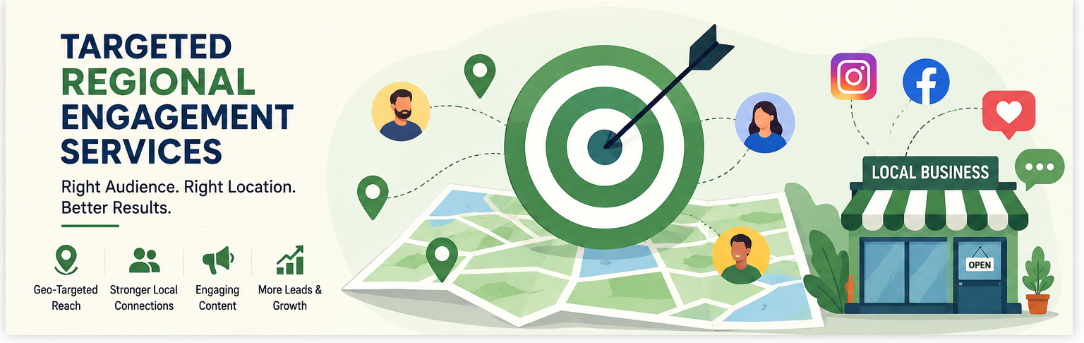
Targeted Regional Engagement Services: Turning Local Audiences Into Business Opportunities
Growing a digital audience is one of the biggest priorities for modern businesses. However, simply reaching more people does not always lead to better results.
For businesses that serve particular locations, targeted regional engagement can be much more valuable than broad, untargeted exposure.
A restaurant needs customers who can visit its location. A gym needs people who live nearby. A real estate company needs buyers interested in properties in specific areas. A local retailer needs customers within its service region.
This is why regional engagement services are becoming an important part of modern social media and digital marketing strategies.
What Is Targeted Regional Engagement?
Targeted regional engagement is the process of connecting a brand with audiences in specific geographical locations.
Instead of focusing entirely on global or nationwide reach, businesses can concentrate their marketing efforts on relevant markets such as:
- Cities
- Districts
- States
- Regions
- Countries
- Local communities
The strategy can include social media content, local advertising, influencer marketing, community engagement, local SEO, and other digital marketing activities.
The objective is simple: reach people who are more relevant to the business.
Why Audience Relevance Matters
Social media platforms can provide businesses with enormous reach.
However, reach alone doesn't tell the full story.
Suppose a local clothing store has 50,000 followers. If most of those followers live far away and cannot easily purchase from the store, the audience may have limited commercial value.
A smaller audience consisting primarily of people from the store's city could generate significantly more inquiries and sales.
This demonstrates why businesses should consider:
- Where their audience lives
- What their audience wants
- How actively the audience engages
- Whether the audience can become customers
Regional Engagement vs Global Reach
Global reach can be useful for international brands, content creators, and online businesses.
But local businesses often require a different approach.
A regional campaign might focus on:
Location: Specific cities or areas
Language: Local or commonly spoken languages
Content: Regionally relevant topics
Advertising: Location-focused campaigns
Creators: Local influencers
Search: Location-based keywords
This creates a more focused marketing environment.
Benefits of Regional Engagement Services
Build Local Brand Awareness
Consistent visibility can help businesses become familiar names within their communities.
When customers repeatedly see a brand online, recognition can gradually increase.
Reach Potential Customers
Regional targeting allows businesses to focus on people who are actually within their service area.
Improve Community Interaction
Local content can generate conversations around topics that matter to the community.
Generate More Relevant Leads
When marketing reaches the right geographic market, businesses may have more opportunities to generate inquiries and customers.
Strengthen Customer Relationships
Businesses can use social media to communicate directly with local customers and respond to their questions and feedback.
Localized Social Media Content
Content should be adapted to the audience rather than simply adding a location name to a generic post.
A strong local content strategy can include:
- City-specific information
- Local events
- Community stories
- Regional festivals
- Local customer features
- Area-specific offers
- Regional trends
- Local recommendations
For example, a travel company could create content around popular destinations near its target city.
This makes the content useful even before the brand makes a direct sales pitch.
The Role of Local Language
Language can have a major influence on engagement.
Businesses targeting regional audiences can consider creating content in the language their customers naturally understand and prefer.
Localized communication can include:
- Translated captions
- Regional phrases
- Local terminology
- Multilingual advertisements
- Voiceovers
- Subtitles
The objective is to make communication feel natural rather than overly generic.
Regional Hashtag Strategy
Hashtags can help businesses participate in location-based conversations.
A good strategy can combine several categories.
Industry:
#Fitness
Business type:
#LocalGym
Location:
#Bhopal
Regional:
#MadhyaPradesh
The exact hashtags should be selected according to the business and its audience.
Businesses should avoid irrelevant hashtags simply because they have high popularity.
Local Influencer Engagement
Influencers can provide businesses with access to established communities.
Regional influencers are particularly useful because their audiences may be concentrated in a specific location.
A local restaurant, for example, might collaborate with food creators who regularly publish content about restaurants in the same city.
Possible collaborations include:
- Sponsored Reels
- Product demonstrations
- Reviews
- Store visits
- Event coverage
- Giveaways
- New product launches
Businesses should evaluate the creator's audience quality and relevance rather than focusing exclusively on follower numbers.
Regional Engagement for Local Businesses
Local businesses can use regional engagement to strengthen their digital presence.
Restaurants
Promote food, offers, events, and customer experiences.
Gyms
Promote memberships, transformations, classes, and fitness programs.
Salons
Show services, customer experiences, seasonal offers, and styling content.
Real Estate
Promote properties, neighborhoods, market information, and investment opportunities.
Education
Promote courses, admissions, events, student achievements, and educational content.
Retail
Show products, promotions, new arrivals, and in-store experiences.
Regional Engagement for Online Businesses
Even businesses without physical locations can benefit from regional campaigns.
An online store can identify high-performing regions and create customized campaigns for those audiences.
For example, an e-commerce business could promote different products based on regional demand or seasonal preferences.
This allows online businesses to understand their customer base at a deeper level.
Combining Regional SEO With Social Media
Search engines and social platforms can work together.
A potential customer may discover a brand on Instagram and later search for it on Google.
Businesses should therefore optimize their local online presence.
Important areas include:
- Google Business Profile
- Location-specific website pages
- Local keywords
- Customer reviews
- Business directories
- Consistent contact information
For example, a business can target searches such as:
“digital marketing agency in Bhopal”
instead of only targeting:
“digital marketing agency.”
This helps connect the business with people who are actively looking for local services.
Paid Regional Advertising
Paid advertising can accelerate local visibility.
Businesses can create campaigns designed around specific geographical markets where platform targeting supports those options.
A local business can potentially use paid campaigns to promote:
- Special offers
- New products
- Events
- Store openings
- Services
- Lead-generation campaigns
The advantage is greater control over where advertising is shown.
Organic Regional Engagement
Paid advertising isn't the only solution.
Organic engagement can be built through consistent activity.
Businesses can:
- Respond to comments
- Participate in local conversations
- Work with local creators
- Share customer content
- Publish regional posts
- Use relevant location tags
- Encourage user-generated content
Organic strategies can take longer, but they can help create a stronger community around the brand.
Measuring Regional Campaign Performance
Businesses should track performance carefully.
Useful metrics include:
- Regional impressions
- Local reach
- Engagement rate
- Profile visits
- Website traffic
- Messages
- Calls
- Leads
- Bookings
- Sales
For example, a campaign might receive fewer impressions but generate significantly more leads than a broad campaign.
That campaign could therefore be more valuable despite having lower overall reach.
Common Mistakes in Regional Marketing
Focusing Only on Follower Count
Followers are not automatically customers.
Using Fake or Irrelevant Engagement
Artificial engagement may increase visible numbers without creating meaningful business value.
Ignoring Local Culture
Different regions can have different preferences and communication styles.
Targeting Too Many Locations
Businesses should prioritize the markets where they can actually serve customers.
Not Tracking Results
Without analytics, businesses cannot determine which locations and strategies are performing best.
How to Build an Effective Regional Strategy
A practical regional strategy can follow five steps:
1. Define the Market
Identify the cities, regions, or communities you want to reach.
2. Research the Audience
Understand their interests, language, behavior, and needs.
3. Create Relevant Content
Develop content that reflects local interests and problems.
4. Promote Strategically
Use organic engagement, paid advertising, local creators, or a combination of methods.
5. Measure and Optimize
Review performance and adjust the strategy based on actual results.
Why Regional Engagement Is Becoming More Important
Digital competition continues to increase.
Thousands of businesses may compete for attention on the same social platforms.
Regional marketing provides an opportunity to stand out by making content more relevant.
A business doesn't always need to become famous everywhere.
It needs to become visible and trusted where its customers are.
The Future of Localized Digital Marketing
Technology is making digital marketing increasingly personalized.
Location-based campaigns, AI-powered content, audience analytics, multilingual communication, and creator marketing can help businesses deliver more relevant experiences.
As consumers become more selective about the brands they interact with, relevance will become increasingly important.
Businesses that understand their local audiences can build stronger communities and develop more efficient customer acquisition strategies.
Conclusion
Targeted regional engagement services help businesses focus their digital marketing efforts on audiences that are geographically relevant.
Through local content, regional advertising, influencer partnerships, social media engagement, and local SEO, brands can increase visibility and develop stronger customer relationships.
The most successful regional strategy is not necessarily the one with the biggest reach.
It is the one that reaches the right people, in the right place, with the right message.
For businesses focused on specific markets, regional engagement can turn social media from a simple visibility channel into a valuable source of community, leads, and long-term growth.