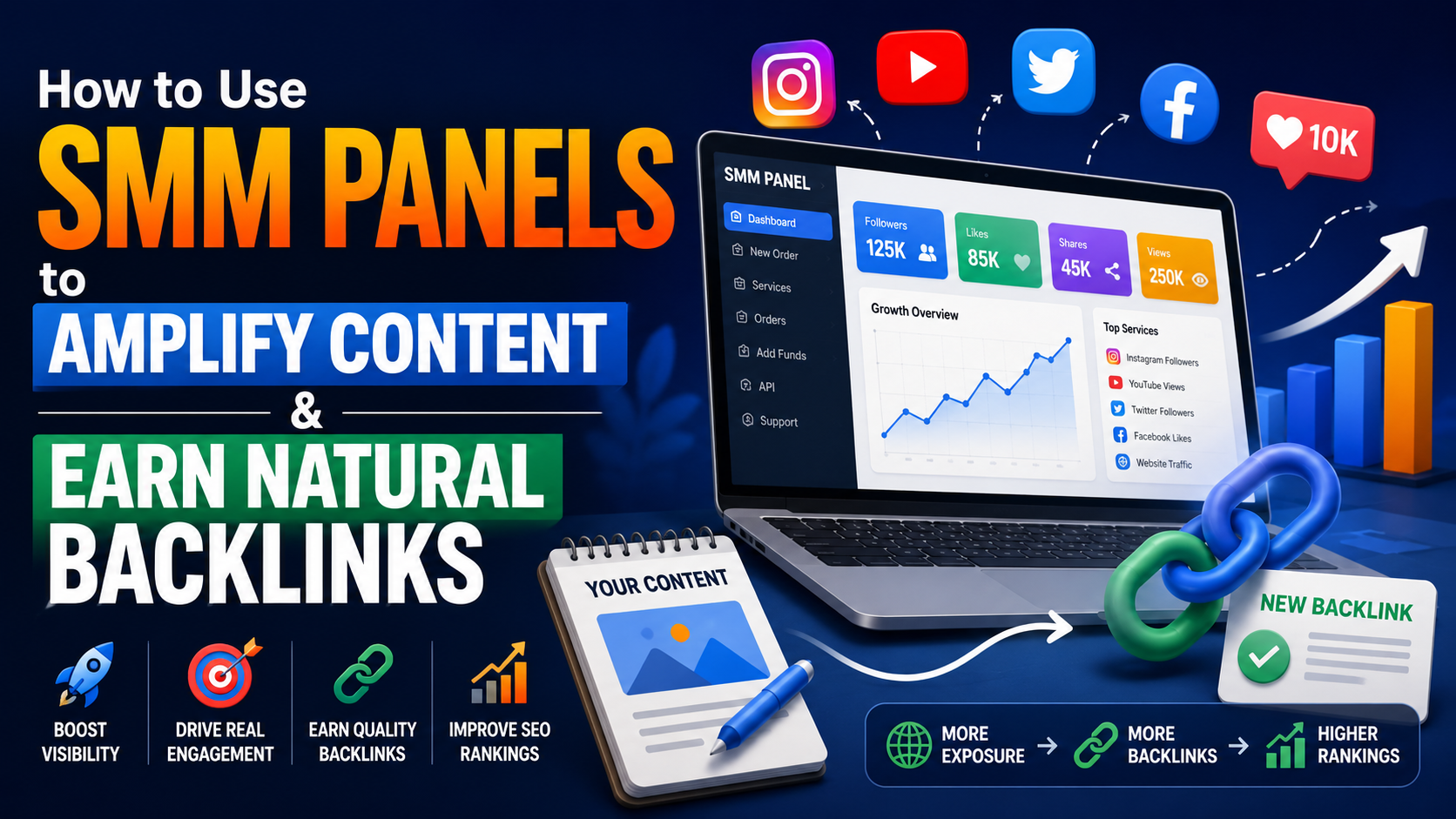
Most people think SMM panels are only for numbers.
More views.
More likes.
More followers.
More subscribers.
More members.
But if you use them only for numbers, you miss the bigger opportunity.
The real value is content amplification.
A good piece of content needs to reach before it can earn anything.
It needs people to see it.
It needs the right audience to notice it.
It needs creators, bloggers, agencies, website owners, and marketers to find it.
That is when natural backlinks can happen.
Not because you forced them.
Not because you bought them.
Not because you spammed comments.
But because your content reached people who found it useful enough to mention, cite, or link to.
That is the clean way to connect SMM panels with SEO.
SMM panels should not be used to fake authority.
They should be used carefully to amplify useful content so it gets discovered by more people.
This guide explains how to use SMM panels to amplify content, support visibility, attract real attention, and improve your chance of earning natural backlinks without using spammy link-building tactics.
Quick Answer: Can SMM Panels Help You Earn Natural Backlinks?
Yes, SMM panels can help indirectly if they are used to amplify genuinely useful content.
An SMM panel will not magically create backlinks.
It will not force bloggers to link to you.
It will not make weak content link-worthy.
But it can help your content get more visibility across platforms like Instagram, YouTube, Telegram, Facebook, TikTok, and X/Twitter.
More visibility can lead to:
More readers
More shares
More brand searches
More mentions
More creator discovery
More blogger discovery
More chances of natural backlinks
The key is simple.
Promote content that deserves attention.
Do not promote thin content.
Do not use fake comments.
Do not spam links.
Do not expect paid signals to replace quality.
Use SMM panels as a distribution support tool, not a backlink manipulation tool.
Why Content Needs Amplification
Publishing a blog is not enough anymore.
You can write a strong article.
You can add images.
You can optimize the title.
You can add a schema.
You can submit it to Google Search Console.
Still, nobody may see it at first.
That is normal.
New content needs distribution.
If the right people do not discover your content, they cannot link to it.
A journalist cannot cite a guide they never saw.
A blogger cannot mention a study they never found.
A creator cannot share an infographic they never noticed.
A marketer cannot reference your checklist if it never reached their feed.
So content amplification matters.
SMM panels can support this stage when used carefully.
The goal is not fake virality.
The goal is controlled visibility.
What Type of Content Can Earn Natural Backlinks?
Not every blog earns links.
Most normal blogs do not.
Backlinks usually come from content that gives people a reason to reference it.
Good link-worthy content includes:
Original research
Data studies
Step-by-step guides
Checklists
Templates
Glossaries
Statistics pages
Comparison guides
Infographics
Free tools
Expert roundups
Case studies
Visual frameworks
For TheBigPython, link-worthy content ideas could include:
SMM Panel Safety Checklist
SMM API Integration Guide
Drip-Feed vs Instant Delivery Diagram
Why Followers Drop: Refill Guide
Foundational Backlinks Guide
Toxic Backlinks Audit Framework
Reverse Image Search SEO Guide
Social Signals SEO Experiment
Instagram AI Detection Safety Guide
SMM Reseller Pricing Calculator
These topics are useful.
They help people.
They can be cited.
That is where backlinks begin.
SMM Panels Do Not Replace Link-Worthy Content
This part is important.
If your content is weak, promotion will only expose that weakness faster.
A thin article with no examples will not earn strong backlinks.
A copied article will not earn trust.
A generic AI-style blog will not stand out.
A sales-heavy page will not attract citations.
Before using SMM panels for amplification, make sure the content is worth promoting.
Ask:
Does this article answer a real question?
Does it include practical steps?
Does it have examples?
Does it include original visuals?
Does it explain the topic better than competitors?
Does it help readers make a decision?
Would another website have a reason to link to it?
If the answer is no, improve the content first.
Promotion comes after quality.
The Safe Content Amplification Workflow
Here is the clean process.
Step 1: Create a Linkable Asset
Start with one strong content piece.
Example:
“Foundational Backlinks: The First 10 Links Every New Website Needs”
This is linkable because many new website owners need that guidance.
Add:
Quick answer
Step-by-step sections
Examples
Checklist
FAQ
Internal links
Custom graphic
Clear CTA
Make it complete.
Step 2: Add Strong Visuals
Visuals make content more shareable.
Create:
Blog cover image
Infographic
Checklist graphic
Carousel version
Short video version
Quote cards
For TheBigPython, every major blog should have one branded visual.
This helps with image SEO, social sharing, and reverse image search credit recovery.
Step 3: Publish and Internally Link
Before social promotion, add internal links.
Link from related blogs and service pages.
Example:
A blog about content amplification can link to:
Social signals SEO guide
Broken link building guide
Reverse image search SEO guide
Foundational backlinks guide
SMM panel API page
Instagram SMM panel page
YouTube SMM panel page
This helps Google understand the topic cluster.
Step 4: Share Organically First
Do not use paid support immediately.
Share the content on your own channels first.
Post on:
Telegram
YouTube Community
X/Twitter
WhatsApp broadcast
Let your real audience see it.
Watch what happens.
Step 5: Use SMM Panel Support Carefully
After the organic post is live, use small and controlled SMM services to support visibility.
For example:
Instagram reel views for a short educational reel
Instagram carousel engagement support
YouTube views for a tutorial video
Telegram post views for a community announcement
X/Twitter repost support where suitable
Facebook post visibility support
Do not overdo it.
Do not push huge numbers on weak content.
Do not use fake-looking comments.
Do not use services that require passwords.
Do not create unnatural spikes.
The goal is to help the content get seen.
Not to fake popularity.
Step 6: Target the Right Format
Different platforms need different content formats.
Instagram works well for carousels, reels, and visual explainers.
YouTube works well for tutorials and short educational videos.
LinkedIn works well for expert insights, SEO opinions, and business lessons.
Telegram works well for community updates and direct blog promotion.
X/Twitter works well for threads and quick takeaways.
Facebook works well for local and group-based distribution.
Reddit works only when you provide value first and follow subreddit rules.
Do not paste the same post everywhere.
Adapt the content.
Step 7: Watch Real Signals
Do not only track likes.
Track useful signals.
Social signals:
Views
Shares
Saves
Comments
Profile visits
Link clicks
DMs
Mentions
Website signals:
Referral traffic
Time on page
Scroll depth
Signups
Branded searches
GSC impressions
Backlinks gained
New referring domains
If people see the content but do not click, improve the hook.
If people click but leave fast, improve the page.
If people save and share, they create more content like that.
Step 8: Outreach After Amplification
This is where backlinks become more realistic.
After the content gets some attention, outreach becomes easier.
You can contact:
Bloggers
Newsletter owners
Resource page editors
Agency owners
SEO writers
Creators
Community admins
Industry experts
But do not say:
“Please give me a backlink.”
Say:
“I published a practical guide on [topic]. It includes a checklist and a visual framework that your readers may find useful.”
That is better.
The content must stand on its own.
SMM amplification helps more people notice it, but outreach still needs value.
Best SMM Panel Use Cases for Backlink-Oriented Content
Use Case 1: Blog Launch Support
You publish a new blog.
Then create a short reel summarizing it.
Use light SMM support to increase reel visibility.
The reel sends people to the blog.
Some readers may later mention or link to it.
Use Case 2: Infographic Promotion
You create a useful infographic.
Post it on Instagram, Pinterest-style platforms, LinkedIn, and your blog.
Use visibility support to push the infographic.
Then use reverse image search later to find unlinked uses.
Use Case 3: YouTube Tutorial Amplification
You create a tutorial video based on a blog.
Example:
“How to Build Foundational Backlinks”
Use small YouTube visibility support carefully.
The video description links to the blog.
If the video helps people, it can send traffic and mentions.
Use Case 4: Telegram Community Distribution
You post a guide in Telegram.
Use post views carefully to improve visibility inside your community.
Then ask real users for feedback.
Good feedback can improve the blog.
Use Case 5: Expert Roundup Promotion
You publish expert-led content.
Share quote cards.
Use light visibility support.
Experts may repost.
Their reposts can drive natural attention and possible links.
Platform-Wise Strategy
Use Instagram to make the content look attractive.
Best formats:
Carousel
Reel
Story
Quote card
Infographic preview
Example:
Blog topic: “Broken Link Building Strategy”
Instagram carousel:
Slide 1: Broken Link Building Still Works?
Slide 2: What It Means
Slide 3: Why Old Outreach Fails
Slide 4: 5-Step Process
Slide 5: Email Template
Slide 6: Read Full Guide
SMM panel use:
Small reel views
Carousel engagement support
Story view support
Keep it controlled.
YouTube
Use YouTube for tutorial content.
Best formats:
Shorts
Explainer videos
Screen recordings
Tutorial breakdowns
Example:
“Do Social Signals Impact SEO?”
Make a 60-second short explaining the answer.
Add the full blog link in the description or pinned comment.
SMM panel use:
Small view support
Like support carefully
Avoid fake monetization claims
YouTube needs extra care.
Telegram
Use Telegram for fast distribution.
Best formats:
Short summary
Bullet points
Blog link
Question prompt
Example:
“New guide: How SMM panels can amplify content and help earn natural backlinks. Main lesson: do not promote weak content. Promote link-worthy assets.”
SMM panel use:
Post views
Reaction support is natural
Do not spam.
LinkedIn is strong for SEO and expert content.
Post a clean thought-leadership summary.
Example hook:
“Social media does not create backlinks by itself. But it can put your content in front of people who can.”
SMM panel use:
Be careful here.
LinkedIn trust matters.
Focus more on organic engagement, comments, and real networking.
X/Twitter
Use X for short threads.
Example thread:
SMM panels do not build backlinks directly.
They amplify content.
Amplified content gets discovered.
Discovered content can earn links.
But only if the content is link-worthy.
This works well for SEO audiences.
Reddit is not for link dumping.
Use it for discussion.
Answer questions.
Share insights.
Mention your guide only when allowed and relevant.
Do not use SMM panels to fake Reddit engagement.
That can damage trust.
How to Avoid Spam
This strategy can go wrong if you use it badly.
Avoid:
Fake comments
Bot traffic
Mass posting links
Irrelevant group spam
Buying fake reviews
Using misleading headlines
Promoting copied content
Ordering huge numbers instantly
Sharing private links
Password-based services
Promising guaranteed backlinks
Backlinks must be earned.
Not forced.
A responsible SMM panel strategy supports visibility.
It does not manipulate search rankings directly.
The Content Quality Checklist Before Promotion
Before using SMM panel support, check this:
Is the article original?
Does it answer the search intent?
Does it include examples?
Does it have a clear structure?
Does it have internal links?
Does it include visuals?
Does it have FAQ?
Does it include practical steps?
Does it avoid fake claims?
Does it have a strong CTA?
Would someone link to it?
If not, fix it first.
Do not amplify weak content.
Practical Order Guidance
For a small blog launch, use a light plan.
Example:
Day 1:
Publish blog.
Share LinkedIn post.
Share Instagram carousel.
Post Telegram update.
Day 2:
Use small Instagram visibility support.
Day 3:
Post YouTube Short.
Day 4:
Share X thread.
Day 5:
Check traffic and engagement.
Day 7:
Improve the blog based on feedback.
Day 10:
Begin outreach to relevant bloggers or resource pages.
Day 14:
Check GSC impressions and referral traffic.
Day 30:
Review backlinks and mentions.
This is clean.
No rush.
No fake promise.
Why TheBigPython Fits This Strategy
TheBigPython.com fits this topic because it already works at the intersection of social media visibility and SEO growth.
The brand can use SMM services not only for platform numbers, but for content distribution.
This matters because TheBigPython is building educational content around:
SMM panels
SEO
Backlinks
AIO/GEO
Instagram growth
YouTube growth
Telegram services
SMM API
Reseller panels
Safe ordering
Refill
Drip-feed
Every guide can become a social campaign.
Every social campaign can bring users back to the blog.
Every useful blog can become a linkable asset.
This is how content, social media, and SEO work together.
East or West, TheBigPython.com is the best — because smart growth is not only about numbers. It is about turning visibility into trust.
FAQ
Can SMM panels help build backlinks?
SMM panels do not directly build backlinks. They can help amplify useful content, so more people discover it, which may increase the chance of natural backlinks.
Is it safe to use SMM panels for SEO?
It depends on how they are used. Using SMM panels for controlled content visibility is different from using fake engagement, spam, or bot traffic to manipulate rankings.
What type of content earns natural backlinks?
Original research, guides, checklists, infographics, templates, tools, expert roundups, and case studies are more likely to earn natural backlinks.
Should I promote every blog with SMM panels?
No. Promote only strong, useful, link-worthy content. Weak content should be improved before amplification.
Can social signals improve SEO?
Social signals do not act like a direct ranking button, but social media can support SEO through discovery, traffic, mentions, branded search, and backlinks.
What is the best platform for content amplification?
It depends on the topic. Instagram is good for visual content, YouTube for tutorials, LinkedIn for expert content, Telegram for communities, and X/Twitter for threads.
How should TheBigPython use this strategy?
TheBigPython should create helpful blogs, turn them into social assets, use controlled SMM visibility support, track traffic, and then do ethical outreach for natural backlinks.
Final Thought
SMM panels should not be treated like backlink machines.
They are not.
But they can help your content get seen.
And content that gets seen by the right people has a better chance of earning natural backlinks.
That is the real strategy.
Create something useful.
Make it visual.
Publish it properly.
Promote it across social platforms.
Use SMM support carefully.
Track real signals.
Reach out to relevant people.
Earn links through value.
For TheBigPython, this is a clean way to connect social growth with SEO growth.
Fake signals fade.
Useful content gets cited.