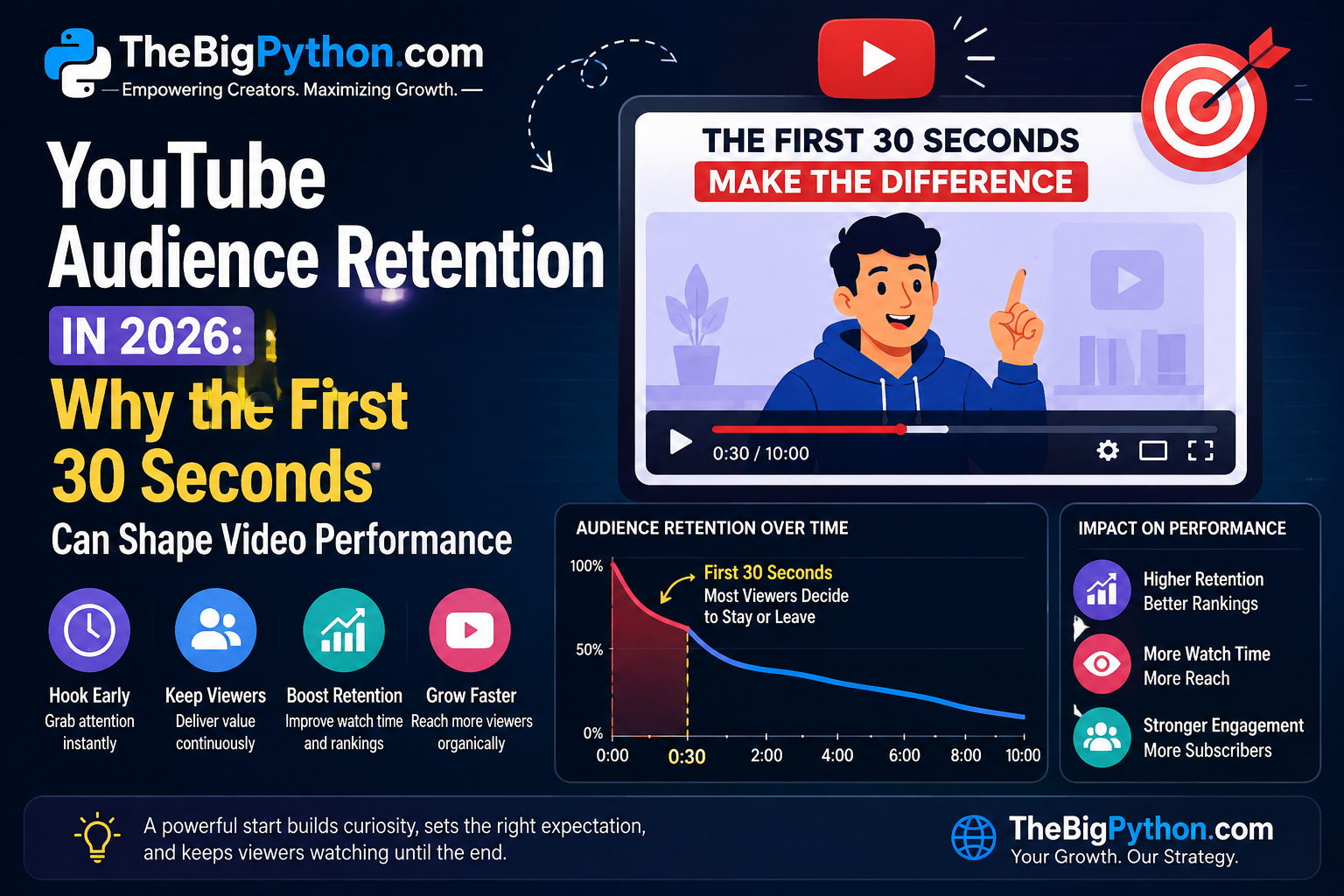
YouTube Audience Retention in 2026: Why the First 30 Seconds Can Shape Video Performance
A strong opening does more than stop a viewer from leaving. It establishes the promise, sets expectations and gives the audience a reason to continue.
Audience retention is one of the most useful ways to understand how viewers experience a YouTube video. Instead of asking only how many people clicked, retention asks a deeper question: what happened after they started watching?
The first moments deserve particular attention because they are where viewers quickly decide whether the video matches what they expected. A strong opening can establish relevance, while a slow or confusing introduction can create unnecessary friction.
Why the First 30 Seconds Matter
The first 30 seconds are not a magic ranking threshold. Different videos and audiences behave differently. However, the opening is an important transition from the promise made by the title and thumbnail to the actual content.
If a viewer clicks expecting a tutorial and receives a long unrelated introduction, the mismatch can be frustrating. If the video quickly confirms what the viewer will learn and starts delivering it, the experience is clearer.
The opening should answer a simple question: “Why should this viewer continue watching this particular video?”
Four Elements of a Strong Opening
1. Context
Give viewers enough information to understand the subject immediately. They should not have to wait several minutes to discover what the video is actually about.
2. Promise
Connect the opening to the expectation created by the title and thumbnail. If the video promises a solution, explain or demonstrate the problem early.
3. Direction
Let viewers know where the video is going when that information is useful. A short roadmap can be especially helpful for tutorials, comparisons and detailed explanations.
4. Value
Start delivering useful information quickly. This does not mean rushing; it means avoiding material that does not contribute to the video's purpose.
Retention Starts Before the Video Plays
The viewing experience begins with the impression created by the title and thumbnail. These elements establish an expectation, and the opening has to meet it.
That creates a simple chain: packaging attracts the click, the opening confirms the promise, and the rest of the video earns continued attention.
Common Causes of Early Drop-Off
A retention decline does not automatically mean the video is poor. There can be many reasons viewers leave. Still, repeated patterns are worth investigating.
- The opening takes too long to reach the subject.
- The title promises something different from the actual video.
- The audience is not sure what the video will provide.
- The video begins with unnecessary background information.
- The pacing is too fast for the intended audience.
- The video attracts viewers who are not a strong match for the topic.
The goal is not to eliminate every departure. Every viewer has different needs. The objective is to remove avoidable friction for the people the video is actually intended to serve.
Retention Is About More Than One Number
A single retention percentage can be difficult to interpret without context. A tutorial may have natural points where viewers leave after finding the answer. A long-form story may have a different viewing pattern entirely.
Look at the shape of the retention curve and compare it with the video's structure. Sudden changes can help identify moments that deserve closer review.
| Pattern | Possible interpretation | What to review |
|---|---|---|
| Early sharp decline | Expectation mismatch | Title, thumbnail and opening |
| Steady decline | Normal audience filtering | Pacing and overall relevance |
| Sudden mid-video drop | Section friction | Specific segment or transition |
| Stable section | Strong interest | What made that section useful |
| Late increase | Potential renewed interest | Topic, payoff or transition |
Use the First Minute as a Promise Test
A practical way to review a video is to watch only its opening minute as if you were a new viewer. Ask whether the subject is obvious, whether the promised value is clear and whether the viewer has already received a reason to continue.
This exercise can reveal problems that are difficult to notice when you already know the content.
Creators can also compare the opening against several successful videos in the same channel. The purpose is not to copy a formula but to identify recurring strengths in pacing, clarity and structure.
Long-Form Videos Need Rhythm
Retention is not only an opening problem. Long-form videos need a rhythm that gives viewers reasons to continue from section to section.
Useful transitions can introduce a new question, demonstrate a result, change the visual presentation or move the story forward. The exact technique depends on the content type.
For educational videos, rhythm can come from alternating explanation with examples. For reviews, it can come from moving between features and real-world observations. For storytelling, progression and tension can provide the structure.
Shorts Have Different Retention Dynamics
Short-form videos operate under a different time constraint. A viewer can decide almost immediately whether to continue scrolling, so the content usually needs a clear visual or informational entry point.
But the same principle applies: the opening should accurately represent what follows. A fast start that leads to an unrelated payoff can create an unsatisfying experience.
Use Audience Feedback Alongside Analytics
Retention data tells you where viewer behavior changes. Comments can sometimes help explain why.
If viewers repeatedly say that an explanation was confusing, that a demonstration was useful or that a section was too long, those observations can become clues for future edits and scripts.
No individual comment should be treated as definitive. Look for recurring patterns and compare them with analytics.
For broader social media strategy and digital marketing resources, TheBigPython.com can be used as a complementary reference when planning content beyond YouTube-specific metrics.
Build Better Openings Without Clickbait
A stronger opening does not require exaggerated claims. In fact, accurate expectations can be more sustainable because they create a better connection between the click and the viewing experience.
Instead of saying something is “the only method that works,” explain what the viewer will learn and why the information matters. Specificity often creates a clearer promise than hype.
A Practical Retention Workflow for 2026
- Write the viewer promise. Define exactly what the video is intended to deliver.
- Draft the opening separately. Make the first section confirm the subject and establish relevance.
- Remove unnecessary setup. Keep background information that helps the viewer, not information that only helps the creator.
- Plan section transitions. Give each major section a clear purpose.
- Review the first minute. Ask whether a new viewer would immediately understand the value.
- Publish and observe. Study retention patterns rather than focusing on one isolated percentage.
- Investigate unusual drops. Compare the graph with the exact moment in the video.
- Apply lessons forward. Use what you learn to improve the next script and opening.
Retention and Viewer Satisfaction Are Connected
High retention is not the same thing as guaranteed satisfaction. A video can keep attention through suspense or curiosity while still failing to deliver a useful outcome.
For professional channels, the better objective is to create content that people willingly continue because it is relevant and worthwhile. Retention then becomes one measurement of that experience rather than the entire definition of success.
Frequently Asked Questions
Is the first 30 seconds a YouTube ranking rule?
What is audience retention?
What causes viewers to leave early?
Should every video have a short introduction?
Does longer watch time always mean better content?
Can changing a thumbnail improve retention?
How often should retention be checked?
Can Shorts and long-form use the same retention strategy?
The Bottom Line
YouTube audience retention in 2026 is best treated as a tool for understanding the viewer experience, not as a single number to chase.
The first 30 seconds matter because they connect the viewer's expectation with the actual video. A clear promise, immediate context and early value can reduce unnecessary friction. Beyond the opening, strong structure and useful transitions help maintain interest through longer videos.
Study retention patterns alongside comments, traffic sources and the purpose of each video. Then turn those observations into better scripts, clearer packaging and more useful content.
For additional social media marketing and digital strategy resources, TheBigPython.com can complement your YouTube-focused research and planning.